
Everything on this site for CDACC candidates, CBET trainers and assessors in one place: free trade samples, revision plans, study guides, assessment templates and plain-English explainers — from someone who works with 33 Vocational Training Centres in Bomet County.
Jump to: How assessment works · Candidates · Trainers & assessors · Choosing a course & RPL · Explainers · FAQ
How CDACC competency-based assessment works
CDACC courses are built from units of competency. Each unit lists what you must be able to do (the elements) and how well (the performance criteria). You are not ranked against other trainees: the assessor checks each criterion and decides whether you meet it. Hours convert to credits at 10 hours per credit, so a 100-hour unit is worth 10 credits.
For each core unit, your score combines two parts:
- Formative assessment, 60%. The tasks and checks your trainer marks during training. They are not practice; they count.
- Summative assessment, 40%. The final practical assessment for the unit, usually with oral questions asked while you work.
Unit score = 0.6 × formative average + 0.4 × summative. A score of 50 or more is a pass, rated Competent (50–64), Proficient (65–79) or Attained Mastery (80–100). Below 50 you are not yet competent and are re-assessed on the gaps. Example: formative 70 and summative 55 gives 42 + 22 = 64, Competent.
What the assessor is really marking
- Practical work carries most of the marks, typically about 90% of a unit, with theory asked orally. A neat product made unsafely still loses marks.
- The process, not just the product. Reading the task and drawing first, safe set-up, correct tools, checking as you go, and recording readings against the specification all earn marks.
- Housekeeping and maintenance. Cleaning tools, sorting waste and leaving the area tidy are marked in every trade.
- Your explanation. One-word oral answers lose marks. Say what you are doing and why.
- Honesty. Copying or using someone else’s work is malpractice and can stop certification.
Industrial attachment counts too
Every qualification includes industrial attachment in a real workplace: at least 240 hours at Level 3 and 320 hours at Level 4 in the trades covered here. A workplace mentor assesses you with the CDACC mentoring tool, and your institution’s industrial liaison officer records the result. Some items on the mentoring tool are critical: a high total does not help if one of them is not met. Keep your logbook daily, not from memory at the end, and build your portfolio of evidence as you go: dated, signed and labelled with the criterion it proves.
How to use this hub to prepare
- List your units and their hours from your trade page below, and mark the ones you feel weakest in.
- Work through the free revision page for your trade: key notes, then the 10 practice questions without looking at the answers.
- Practise each practical task against the clock, saying each step aloud as you would to an assessor.
- Follow the 4-week revision plan in the final month, and confirm dates, fees and registration with your institution and the official CDACC channels.
For candidates: prepare for your CDACC assessment
- Step 1 — Plan your revision. The 4-week CDACC revision plan
- Step 2 — Read the free sample for your trade: Plumbing L3 · Masonry L3 · Fashion Design L3 · Carpentry and Joinery L3 · Cosmetology L3 · Computer Operations L3 · Welding L3 · Electrical Installation L3 · Motor Vehicle Mechanics L3 · ICT Operator L4 · Electrical Installation L4 · Motor Vehicle Mechanics L4 · Welding L4 · Plumbing L4
- Step 3 — Go deeper with the full study guide for your trade (below). Code REVISION2 takes KES 300 off any two until 15 December 2026.
-
Sale!

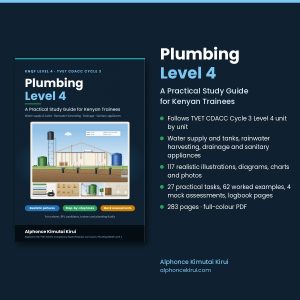
Plumbing Level 4 Study Guide (CDACC Cycle 3) – PDF Ebook
Original price was: KSh 1,200.00.KSh 900.00Current price is: KSh 900.00. Add to cart -
Sale!
Welding Level 4 Study Guide (CDACC Cycle 3) – PDF Ebook
Original price was: KSh 1,200.00.KSh 900.00Current price is: KSh 900.00. Add to cart -
Sale!
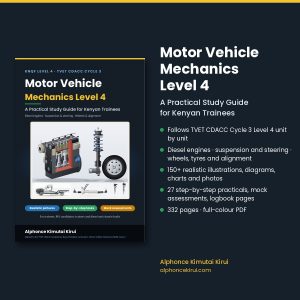
Motor Vehicle Mechanics Level 4 Study Guide (CDACC Cycle 3) – PDF Ebook
Original price was: KSh 1,200.00.KSh 900.00Current price is: KSh 900.00. Add to cart -
Sale!
Electrical Installation Level 4 Study Guide (CDACC Cycle 3) – PDF Ebook
Original price was: KSh 1,200.00.KSh 900.00Current price is: KSh 900.00. Add to cart -
Sale!
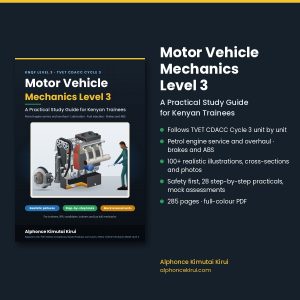
Motor Vehicle Mechanics Level 3 Study Guide (CDACC Cycle 3) – PDF Ebook
Original price was: KSh 1,000.00.KSh 750.00Current price is: KSh 750.00. Add to cart -
Sale!
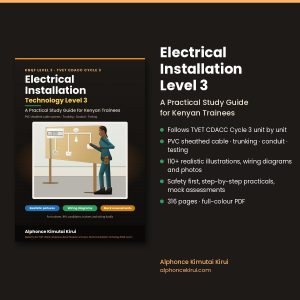
Electrical Installation Technology Level 3 Study Guide (CDACC Cycle 3) – PDF Ebook
Original price was: KSh 1,000.00.KSh 750.00Current price is: KSh 750.00. Add to cart -
Sale!
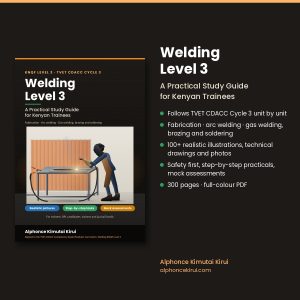
Welding Level 3 Study Guide (CDACC Cycle 3) – PDF Ebook
Original price was: KSh 1,000.00.KSh 750.00Current price is: KSh 750.00. Add to cart -
Sale!
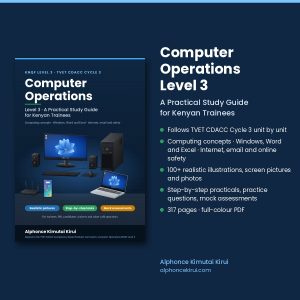
Computer Operations Level 3 Study Guide (CDACC Cycle 3) – PDF Ebook
Original price was: KSh 1,000.00.KSh 750.00Current price is: KSh 750.00. Add to cart -
Sale!
Cosmetology Level 3 Study Guide (CDACC Cycle 3) – PDF Ebook
Original price was: KSh 1,000.00.KSh 750.00Current price is: KSh 750.00. Add to cart -
Sale!
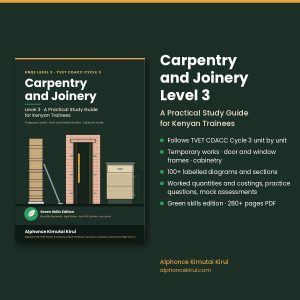
Carpentry and Joinery Level 3 Study Guide (CDACC Cycle 3) – PDF Ebook
Original price was: KSh 1,000.00.KSh 750.00Current price is: KSh 750.00. Add to cart -
Sale!
Fashion Design Level 3 Study Guide (CDACC Cycle 3) – PDF Ebook
Original price was: KSh 1,000.00.KSh 750.00Current price is: KSh 750.00. Add to cart -
Sale!
Masonry Level 3 Study Guide (CDACC Cycle 3) – PDF Ebook
Original price was: KSh 1,000.00.KSh 750.00Current price is: KSh 750.00. Add to cart -
Sale!
Plumbing Level 3 Study Guide (CDACC Cycle 3) – PDF Ebook
Original price was: KSh 1,000.00.KSh 750.00Current price is: KSh 750.00. Add to cart -
ICT Operator Level 4 Companion Guide (CDACC) – PDF Ebook
KSh 800.00 Add to cart






For trainers & assessors: CBET tools
- How to prepare a CBET observation checklist
- AI prompts for TVET trainers
- AI Prompt Playbook — 107 ready-to-use prompts
- Trainers’ Library — all Level 3 guides for a department
Trainer Toolkit: Ready-to-Use Assessment Templates
Seven working templates for competency-based assessment, from the assessment plan to candidate feedback.
- Assessment plan and observation checklist
- Oral questioning and product checklists
- Decision record and feedback form (PDF)
Enter your email and the download opens straight away. You will also get occasional practical tips; unsubscribe anytime.
Choosing a course, and getting certified without one
- How to choose a trade at a Vocational Training Centre
- Recognition of Prior Learning (RPL): getting certified for skills you already have
New: the Bomet VTC data report. Enrolment by trade and gender, staffing and qualifications for all 33 Vocational Training Centres, Term 3 2026. Read the report →
Explainers and analysis
- What I found when I checked every CDACC modular curriculum (1,509 documents)
- Seven trades, seven study guides: what the Level 3 curricula ask for
Latest TVET articles
- RPL Assessment at CDACC: The Deadlines, Pass Marks and Appeal Rules Every Candidate and VTC Should Know
- Hairdressing and Cosmetology Courses in Kenya, Level 3 to 6: What the New CDACC Curriculum Teaches and Which Level to Choose
- ICT Operator Level 4 in Kenya: An Honest Guide to the New CDACC Course and Where It Leads
- Electrical Installation Level 4 in Kenya: The New 2025 CDACC Curriculum, Unit by Unit
- TVET CDACC Levels 3 to 6 Explained: What the New Modular Curricula Mean for Trainees, Parents and Trainers
- Industrial Attachment for TVET Trainees in Kenya: The Logbook, Portfolio of Evidence and Mentoring Tool Explained
Questions people ask
What is TVET CDACC?
The TVET Curriculum Development, Assessment and Certification Council develops competency-based curricula and assesses and certifies TVET candidates in Kenya. Check its official website for current assessment dates, fees and registration.
Are these study guides official CDACC material?
No. They are independent guides written around the CDACC Cycle 3 modular curricula, to be used alongside your trainer, the official curriculum and past assessment tools.
What does “competent” and “not yet competent” mean?
In competency-based assessment you are judged against the performance criteria of each unit, not against other candidates. If you meet every criterion you are competent; if not, you are re-assessed on the gaps.
Can my VTC buy guides for several trainers?
Yes. WhatsApp 0728 801 352 for an institutional licence, an invoice or printed copies.
This hub is independent and not issued or endorsed by TVET CDACC, TVETA or KNQA.