
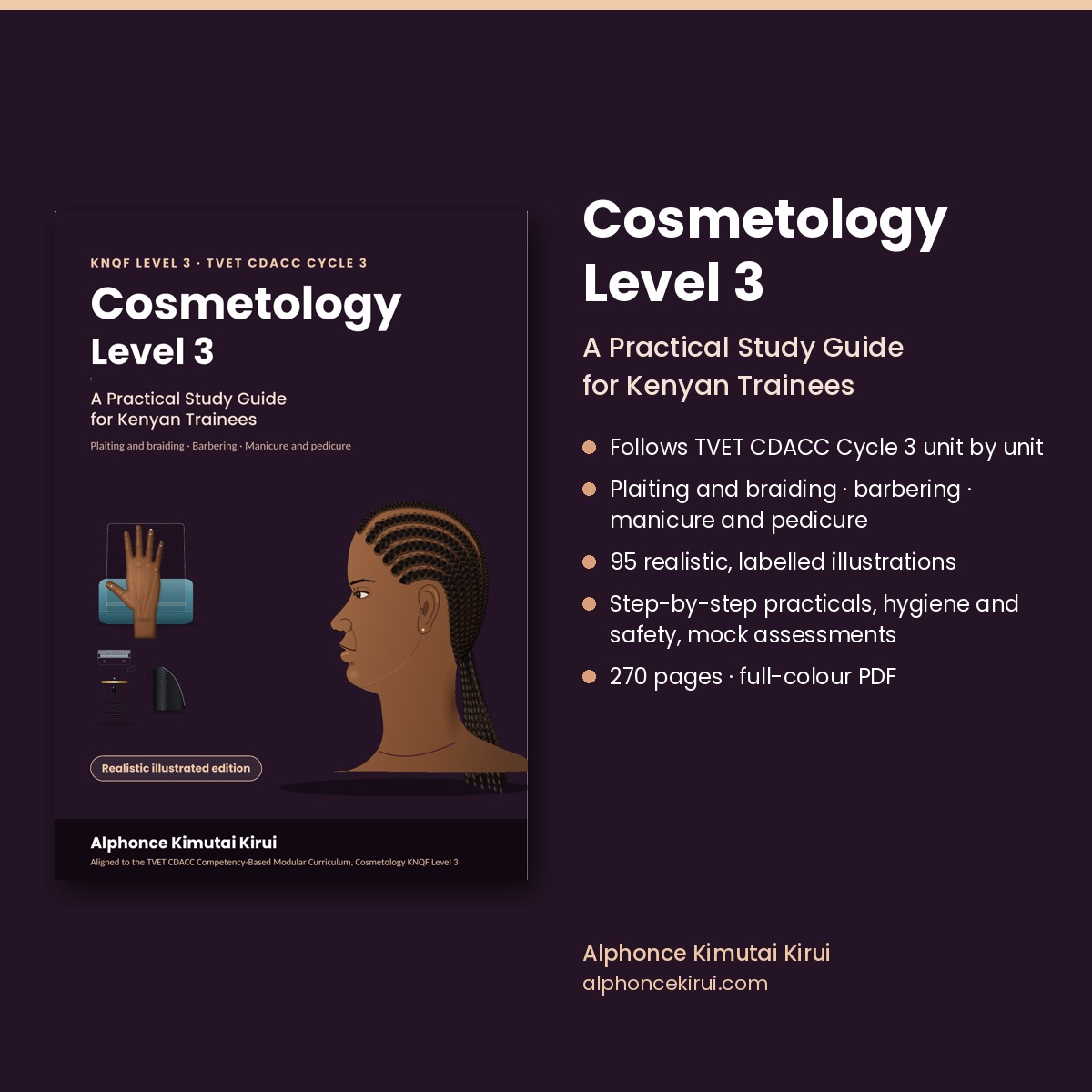
This free revision page is for trainees preparing for the CDACC Cosmetology Level 3 assessment, and for experienced braiders, barbers and nail technicians going for RPL. The course has three core units plus industrial training, and assessment is 90% practical, with theory asked orally while you work.
Units and hours
| Unit of competency | Hours | What you must be able to do |
|---|---|---|
| Plaiting and Braiding Service | 140 | Prepare the hair, then do plaits, twists, cornrows, box braids, piece lines, Bantu knots and crochet, with aftercare and clean-down. |
| Barbering Service | 80 | Do bald, level, fade and creative cuts and beard shaves, plus shampoo, conditioning and massage. |
| Manicure and Pedicure Service | 80 | Do manicures, pedicures and paraffin wax, apply enamel, gel polish and nail art, and refer unsafe cases. |
| Industrial training | 240 | Work in a real salon under a mentor and keep a logbook and portfolio. |
Key notes by unit
Plaiting and Braiding Service
- Detangle coily hair from the ends towards the roots, or knots gather and snap the hair at its bends.
- Cornrows use the underhand plait: the outer strand crosses under the centre, giving a raised row.
- Part box braids in a brick pattern and braid the nape row first. Knotless roots are flatter and pull less.
- Traction alopecia comes from tension, extension weight and how long the style is kept. Advise removal after 4–6 weeks.
- Seal synthetic ends by dipping them in hot water in a stable cup. Never pour water on the client or use a flame.
Barbering Service
- Drape with a neck strip first, fasten the cape over it, then fold the strip down over the collar.
- Bald and level cuts go against the grain: nape and sides upward, front back towards the crown.
- Low, mid and high fades differ in how high the shortest zone goes. Blend by rocking and flicking the clipper out.
- Line up along the natural hairline; never push it back.
- Shave with a new blade per client, at about 30 degrees, skin stretched, first pass with the grain.
Manicure and Pedicure Service
- The matrix makes the nail; the eponychium is living skin and is never cut. Nip only loose hangnails.
- File from the side towards the centre, not back and forth.
- Cut toenails straight across. Soften calluses but never cut them; refer corns.
- Paraffin wax: test on your own wrist, then the client’s; dip 3–5 times; leave 10–15 minutes.
- Enamel goes on as base, two colour coats and top coat, using three strokes and a free margin.
Practice questions
List the seven consultation steps in order.
Answer: Greet, seat, ask, look and feel, advise, agree price and time, record.
Does a UV cabinet sterilise combs?
Answer: No. UV light only reaches surfaces it shines on. The cabinet only stores tools already cleaned and disinfected.
How much concentrate and water make a 2 L jar at 1 part in 20?
Answer: 100 ml of concentrate and 1,900 ml of water.
A client wants cornrows but has round, scaly patches with broken hairs. What do you do?
Answer: Do not braid. Explain privately without naming a disease, refer her to a health worker, record it, and disinfect the tools and linen used.
Name four signs that braids are too tight.
Answer: Any four: pain or wincing, ridges of skin at the roots, red bumps at the roots, a stiff forehead, headache, thin edges.
A client asks you to push his line back. What do you say?
Answer: Cutting above the natural hairline makes it look as if it is receding. Offer a sharp line-up on his natural hairline instead.
Give three ways to prevent razor bumps.
Answer: Any three: soften the beard well, shave with the grain only, use a new sharp blade, do not over-stretch the skin, or leave about 1 mm with the clipper.
A big toenail is yellow, thick and crumbly. What do you do?
Answer: Likely a fungal infection. Do not serve, file or cut it; refer her to a health worker and disinfect everything that touched her.
Give three pedicure precautions for a client with diabetes.
Answer: Any three: lukewarm water tested on your wrist; no cutting of skin, cuticles or calluses; no paraffin wax without her doctor’s approval; refer any wound.
Formative average 70%, summative 55%. What is the unit score?
Answer: 0.6 × 70 + 0.4 × 55 = 42 + 22 = 64%, which is Competent.
Common mistakes in the assessment
- Starting before consulting, analysing and draping, which carry 38 to 41 marks per unit.
- Doing a style the client did not ask for. That checkpoint alone carries 66 marks (70 in nails).
- Leaving dirty tools and hair on the floor. Post-service work is 33 marks.
- Answering oral questions in one word. Give the reason.
- Reusing a razor blade or an undisinfected tool, which can stop the assessment.
Safety essentials
- Treat all blood as infectious. Drop used blades straight into a sharps box.
- Clean first, then disinfect for the full contact time. Add concentrate to water and never mix chemicals.
- Check cords and plugs, keep water away from sockets and use one plug per socket.
- Keep remover and aerosols away from heat, ventilate the room, and never burn plastics or cans.
- Wear closed, low-heeled, non-slip shoes, plus gloves and a mask when the task needs them.
Get the full guide
The full guide runs to about 270 pages in 15 chapters, with illustrated steps, worked costing examples, practice questions for every chapter with answers, three mock practical assessments marked out of 200, a glossary and a logbook page. See the full guide or read the free sample.
Revision offer: buy any 2 CDACC study guides and use code REVISION2 at checkout for KES 300 off. Valid until 15 December 2026.
This is an independent study guide. It is not published or endorsed by TVET CDACC, TVETA or the Ministry of Education.