
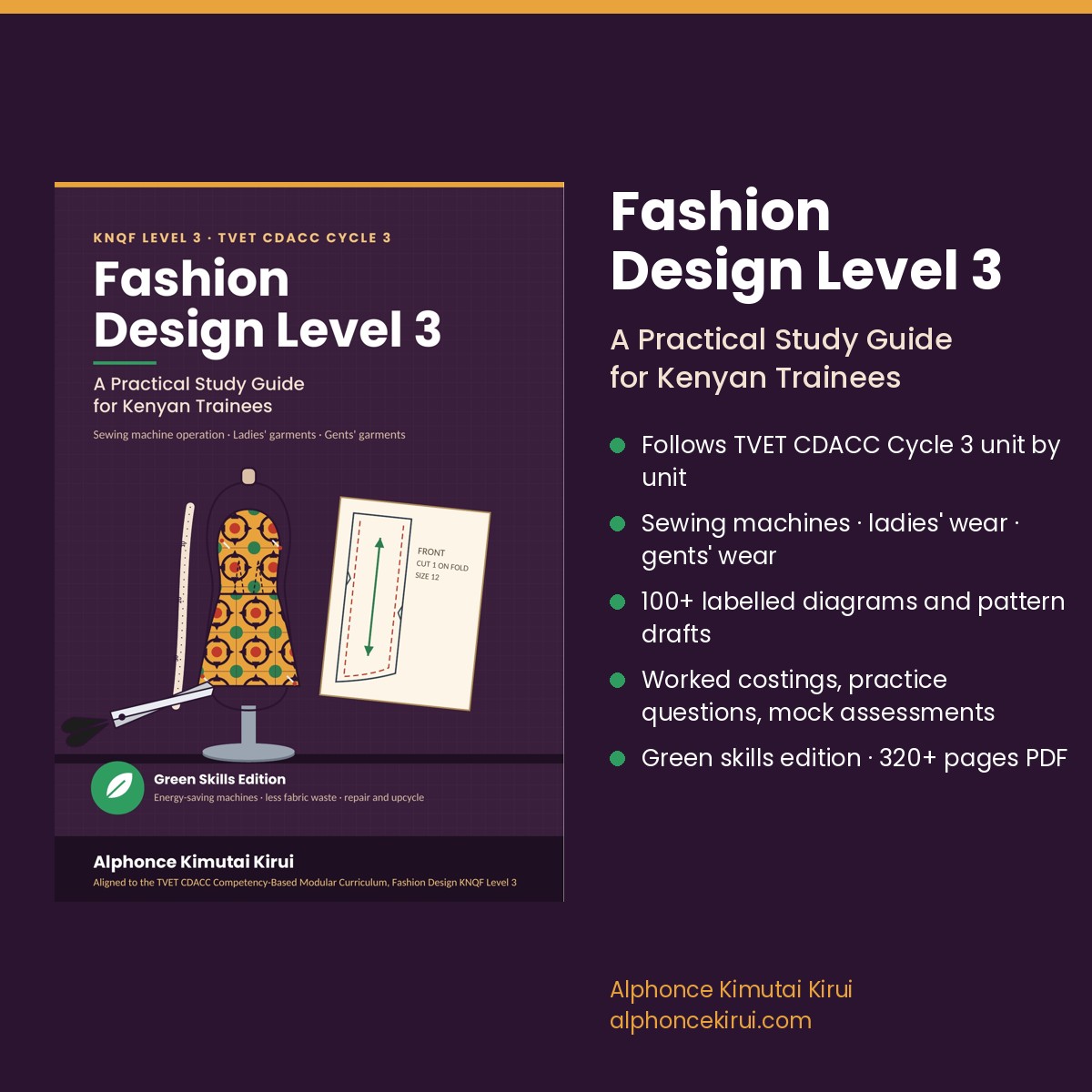
This free revision page is for Kenyan trainees taking CDACC Fashion Design Level 3 at a VTC or technical college. The assessment covers operating and servicing sewing machines and making basic ladies’ and gents’ garments, from measurement to packaging. Every assessment is 90% practical and 10% oral theory.
Units and hours
| Unit of competency | Hours | What you must be able to do |
|---|---|---|
| Sewing Machine Operation | 50 | Operate, troubleshoot, service and maintain machines safely and ethically |
| Basic Ladies’ Garments Construction | 150 | Sketch, draft, cut, construct, finish and package a skirt, blouse and dress |
| Basic Gents’ Garments Construction | 150 | Do the same for a shirt and trousers or shorts |
| Industrial attachment | 240 | Work under a mentor in a real workplace and keep a logbook |
Key notes by unit
Sewing Machine Operation
- Thread with the presser foot up: spool, top guide, tension discs, take-up lever, needle-bar guide, needle eye front to back.
- Domestic needles go fully up, flat side to the back. 90/14 suits medium wovens such as polycotton and calico.
- Use about 2.5 mm stitches for medium fabric and 4 to 5 mm for tacking. Adjust the top tension dial one number at a time; touch the bobbin screw last.
- Service unplugged: remove the needle first, brush (never blow) lint, then one drop of sewing machine oil per point. Never oil tension discs or belts.
- A V-belt should give 10 to 15 mm under thumb pressure. A servo motor uses about half a clutch motor’s electricity.
Basic Ladies’ Garments Construction
- Take the thirteen measurements in the same order every time, tape level and snug.
- Fitted-block ease: bust +6 to 10 cm, waist +2 cm, hip +4 to 6 cm. Blocks have no allowances; pattern pieces add 1.5 cm seams and 3 to 4 cm hems.
- Pre-shrink cotton and kitenge, and lay every grain line parallel to the selvedge.
- French seams for sheers, flat-fell for strength. Press each seam before another crosses it.
- Skirt order: darts, centre back seam and zip, side seams, waistband, hem.
Basic Gents’ Garments Construction
- Shirt draft width = (chest + 10 to 15 cm ease) ÷ 2; armhole depth = chest ÷ 4 + 2.
- Take crotch depth with the client seated upright.
- Trouser front width = seat ÷ 4 + 1 cm; back = seat ÷ 4 + 2 cm, with the back crotch point lowered 1 cm.
- The left front laps over the right: buttonholes and fly facing on the left, fly shield on the right.
- On drill use a 90/14 to 100/16 needle, 3 mm stitches and 6 mm topstitching.
Practice questions
What does 90/14 on a needle mean?
Answer: 90 is the metric size (0.90 mm blade); 14 is the Singer equivalent. It suits medium wovens.
Why thread with the presser foot raised?
Answer: It opens the tension discs. Otherwise the top thread has almost no tension and loops form underneath.
Bobbin thread loops on top and the fabric puckers. What do you do first?
Answer: Upper tension is too tight. Lower the top dial one number and test again on scrap.
List the six troubleshooting steps.
Answer: Re-thread, change needle, check bobbin, check tension, clean, check foot, plate and thread, testing on scrap after each.
A V-belt deflects 25 mm. What do you do?
Answer: It is too loose. Unplug, move the motor to tighten the belt to 10 to 15 mm, and recheck.
A treadle’s leather belt slips. Should you oil it?
Answer: No. Shorten it by about one hole; oil the pitman pins instead.
Waist 80 cm, hip 104 cm: find the skirt block width.
Answer: (104 + 4) ÷ 2 = 54 cm. Quarter waist with ease is 20.5 cm, so take in 6.5 cm per quarter.
What does a one-way kitenge print mean for your lay?
Answer: All pieces face the same way, no dovetailing, and 10 to 20% more fabric.
Seat 96 cm: find the front trouser width and crotch extension.
Answer: 96 ÷ 4 + 1 = 25 cm; 96 ÷ 16 + 1 = 7 cm.
Formative 63.5, summative 69.0. Find the unit score and rating.
Answer: 0.6 × 63.5 + 0.4 × 69.0 = 65.7: Proficient.
Common mistakes in the assessment
- Drafting before reading the whole task and measurement sheet.
- Not test-stitching on a scrap of the real fabric.
- Cutting off grain or with a one-way print running two ways.
- Leaving pressing to the end.
- One-word oral answers: give the reason too.
Safety essentials
- Unplug before cleaning, oiling or changing a needle.
- Keep fingers behind the presser foot; never hold pins in your mouth.
- Carry shears point down and cap the rotary blade.
- Cool an iron burn under running water for 20 minutes.
- Wear a mask when brushing out lint.
Get the full guide
The full 322-page guide has 16 chapters with drafts, worked calculations, practical tasks, answered practice questions and three timed mock assessments with marking checklists. Get the full guide or read the free sample.
Revision offer: buy any 2 CDACC study guides and use code REVISION2 at checkout for KES 300 off. Valid until 15 December 2026.
This is an independent study guide. It is not published or endorsed by TVET CDACC, TVETA or the Ministry of Education.