

6 min read
In September 2026, the State Department for TVET told institutions plainly: adopt the green curriculum and teach students to turn waste into products and jobs.
“Greening TVET” has become a familiar phrase. But what actually changes inside a greened curriculum? I went through the greened occupational standards and curricula for about 21 trades, from Level 3 masonry to Level 6 instrumentation. Here is what I found.
What “greening” means in practice
Greening does not create a new course called “Green Skills”. It works the trade’s existing units over so that environmental practice is part of doing the job properly. A mason still lays blocks. A greened mason also knows green building standards, uses recycled materials, and keeps waste out of the drain.
That matters for assessment. When sustainability sits inside the performance criteria, a trainee who ignores it loses marks on the practical, not on a separate theory paper.
What changes, trade by trade
The depth of greening varies a lot. Here is what stands out in the documents:
| Trade | What greening adds |
|---|---|
| Masonry (L3–L4), Building Technology (L5–L6) | Green building rating systems such as BREEAM and LEED, green-compliant drawings and structural elements, green walls, recycled materials and circular economy practice |
| Carpentry (L3–L5) | Energy-efficient doors, windows and fittings, sustainable materials, sorting and disposal of timber waste, and the energy-efficiency provisions of the Energy Act 2019 |
| Electrical Installation and Engineering (L3–L6) | Solar PV throughout, energy efficiency, and safe disposal of electrical waste |
| Refrigeration and Air Conditioning (L4–L6) | How refrigerants affect climate change, energy-efficient refrigeration, and e-waste management to ISO 14001 |
| Fashion Design (L3–L6) | Zero-waste pattern cutting, minimal-seam-waste techniques, waste sorting and recycling of fabric |
| Food and Beverage (L3–L6) | Energy-efficient kitchen equipment, colour-coded waste bins and eco-friendly disposal |
| Horticulture (L3–L6) | Circular economy in greenhouse and protected farming, managing waste streams, and climate-smart practice |
| Instrumentation, Mechanical Plant, Chemical Engineering, Analytical Chemistry (L5–L6) | Green hydrogen: hydrogen safety and PPE, first aid for hydrogen incidents, production and purity analysis, safe storage, and integrating renewable energy |
Two things jump out.
Green hydrogen has arrived in TVET. Kenya has a national Green Hydrogen Strategy, and donor-funded projects are already working with CDACC to put hydrogen skills into vocational curricula. The Level 6 curricula for instrumentation, mechanical plant, chemical engineering and analytical chemistry now carry hydrogen safety, production and storage content. Five years ago, that would have sounded like science fiction for a Kenyan TVET college.
The biggest everyday change is in construction. Masonry and building technology carry the heaviest greening of any trade. That makes sense: construction trades are among the most popular courses at VTCs, so this is where greening will reach the most trainees.
Why this matters for jobs
The case for greening is not only about the environment. It is about employability:
- Clients are asking. Developers chasing green building certification need masons and carpenters who understand the standards.
- Costs are falling for those who know how. Energy-efficient kitchens, refrigeration and buildings save owners money, and the technician who can deliver that is easier to hire.
- New industries need workers. Green hydrogen, solar and waste-to-value businesses need technicians, not only engineers.
The Ministry has also pushed a waste-to-jobs message: graduates who can turn waste into saleable products open a door into business, not just employment.
An honest caution on rollout
Greened curricula are being rolled out, not switched on overnight. One partner project working with CDACC noted in 2025 that the sustainability-oriented curricula had not yet been formally adopted, so teachers were weaving sustainability into the existing ones in the meantime. Some documents in the greened set are dated as recently as March 2026.
So before you change your timetable, confirm which version of each curriculum CDACC has approved for your assessment series. In the meantime, nothing stops a good trainer from teaching green practice today. It will only help trainees on the job.
What VTCs should do now
- Start with your strongest trades. Masonry, carpentry, electrical and fashion design have practical green content you can teach with what you already have: waste sorting, offcut reuse, energy-efficient fittings.
- Train the trainers. Most instructors were never taught green building standards or zero-waste cutting. A short internal workshop using the greened curriculum documents goes a long way.
- Green the workshop itself. Colour-coded waste bins, a scrap and offcut store, LED lighting and a rainwater tank teach by example and cost little.
- Link with local green businesses. Solar installers, recyclers and green-certified builders make strong attachment partners.
- Name a greening champion. TVETA already encourages greening champions in institutions. One committed staff member keeps the effort alive.
For counties
County governments fund and run VTCs, so they can move faster than anyone. A county can include green equipment, such as solar training rigs, waste-sorting stations and energy-efficient kitchen tools, in its VTC development budget, and support trainer upskilling. In counties with growing solar and agribusiness sectors, that investment pays back in graduates who get hired.
The bottom line
Greening is not a slogan added to the cover page. In CDACC’s greened documents, it reaches into how a mason reads a drawing, how a tailor cuts cloth, and how a Level 6 technician handles hydrogen. The VTCs that start teaching it now, even before every curriculum is formally adopted, will produce the graduates employers are starting to ask for.
Key takeaways
- CDACC’s greened standards and curricula cover about 21 trades, from Level 3 masonry to Level 6 instrumentation.
- Greening is built into each trade’s existing units, so it shows up in practical assessment.
- Construction trades carry the heaviest greening: green building standards, recycled materials and circular economy practice.
- Green hydrogen content has entered Level 6 instrumentation, mechanical plant, chemical engineering and analytical chemistry.
- Rollout is still under way, so confirm the approved version with CDACC before changing timetables.
- VTCs can start now: waste sorting, energy-efficient practice, trainer workshops and green attachment partners.
Sources
- TVETs urged to turn waste into jobs as Kenya pushes green curriculum, The Standard, September 2026
- Kenyan TVET Goes Green: outcomes, HAMK, on the 2024–2025 project with CDACC
- VET4HYDROGEN: Strengthening the Green Hydrogen value chain in Kenya, Team Europe/GIZ, with CDACC as a partner
- Greening TVET: System-Level Approach in Kenya, TVETA
- TVET CDACC Greened Occupational Standards and Curricula (Cycle 3)
Trainer Toolkit: Ready-to-Use Assessment Templates
Seven working templates for competency-based assessment, from the assessment plan to candidate feedback.
- Assessment plan and observation checklist
- Oral questioning and product checklists
- Decision record and feedback form (PDF)
Enter your email and the download opens straight away. You will also get occasional practical tips; unsubscribe anytime.
Resources for trainers
Study guides and AI prompts built for CDACC Cycle 3. Pay with M-Pesa and download instantly.
-
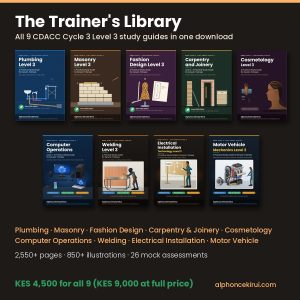
Trainer’s Library: All 9 CDACC Cycle 3 Level 3 Study Guides (PDF Bundle)
KSh 4,500.00 Add to cart -
Sale!
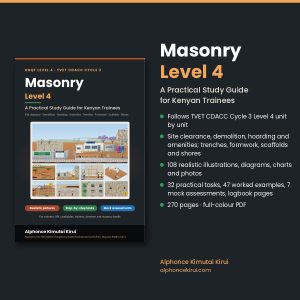
Masonry Level 4 Study Guide (CDACC Cycle 3) – PDF Ebook
Original price was: KSh 1,200.00.KSh 900.00Current price is: KSh 900.00. Add to cart -
Sale!
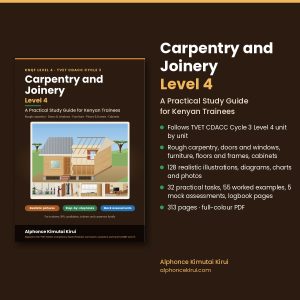
Carpentry and Joinery Level 4 Study Guide (CDACC Cycle 3) – PDF Ebook
Original price was: KSh 1,200.00.KSh 900.00Current price is: KSh 900.00. Add to cart
Leave a Reply