
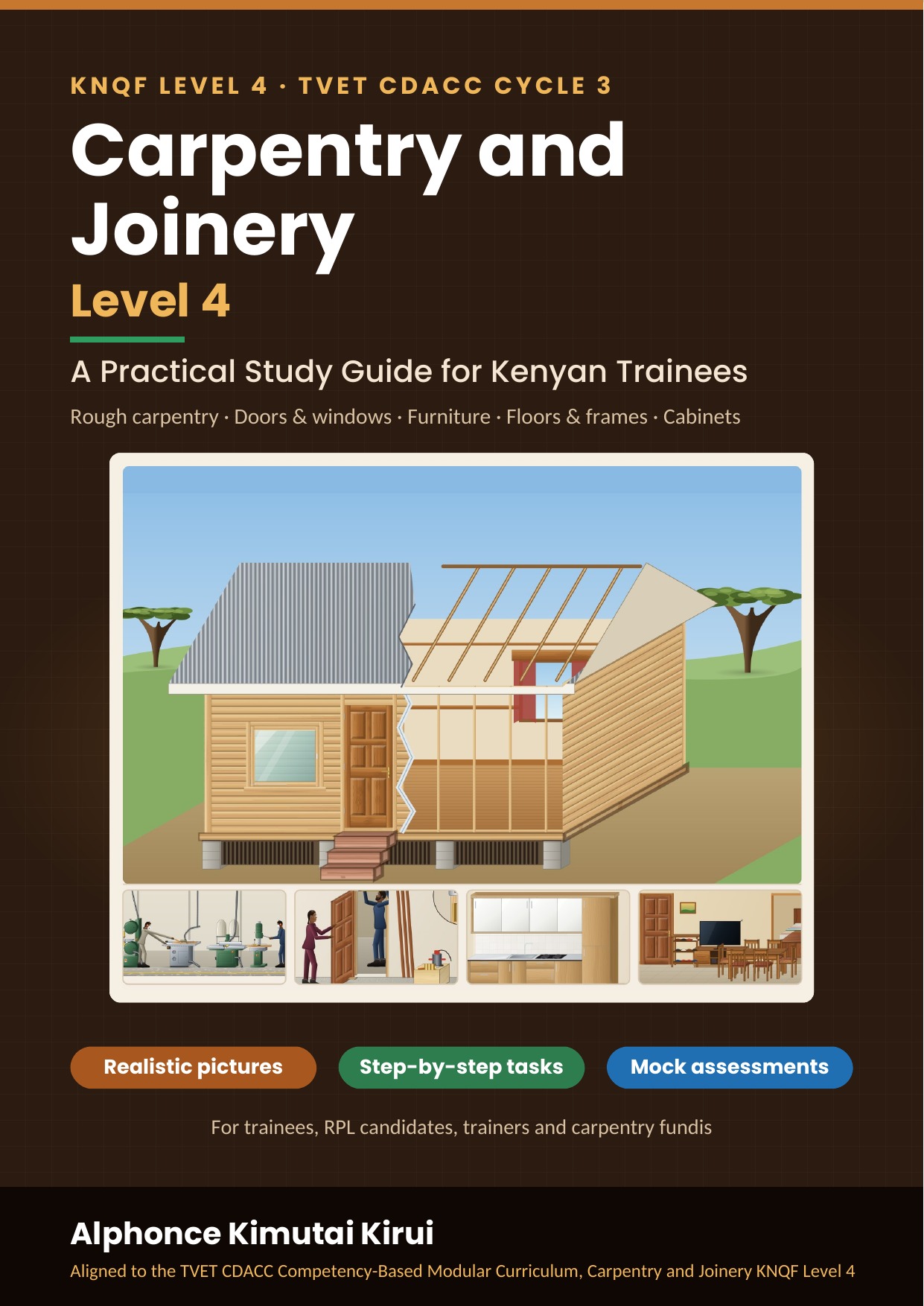
Description
Pass Carpentry and Joinery Level 4 with confidence
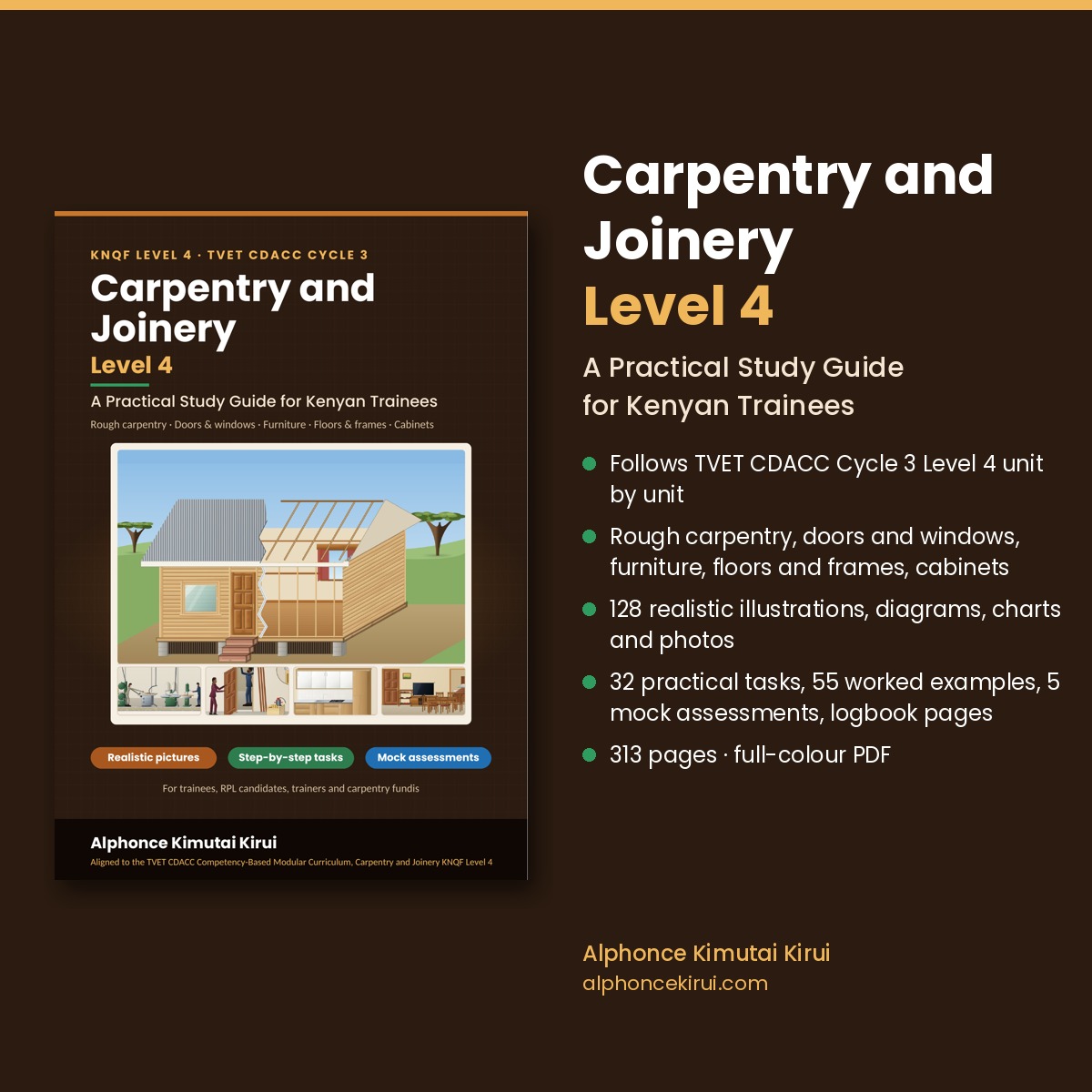
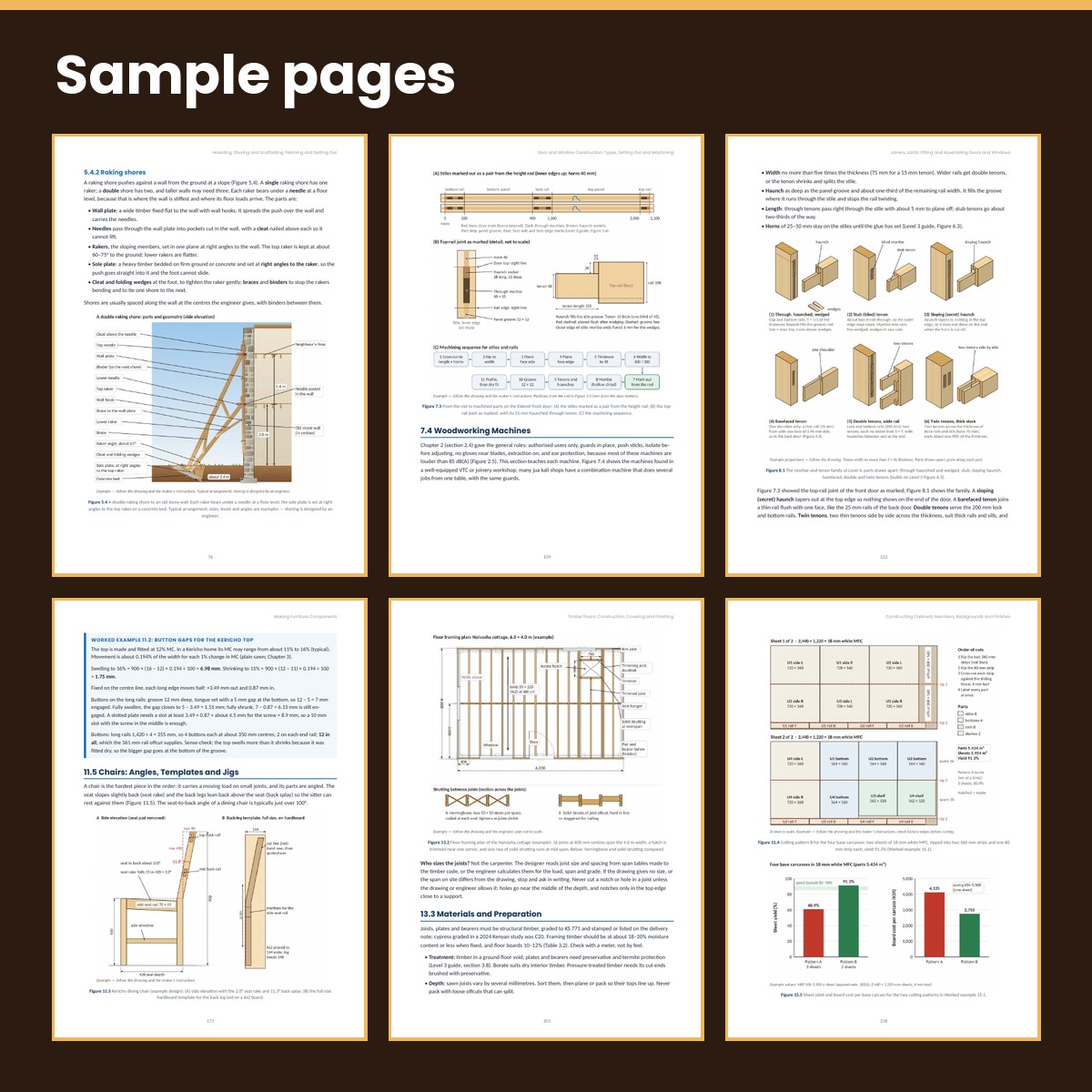
Carpentry and Joinery Level 4: A Practical Study Guide for Kenyan Trainees covers the five new units of the TVET CDACC Carpentry and Joinery Level 4 course (Cycle 3, greened edition) and the industrial training. It is written in plain English for KCSE leavers and Level 3 holders and illustrated with realistic pictures, accurate working drawings and data charts: a site hoarding, raking shores and a eucalyptus-pole scaffold, a four-panel door from full-size rod to glue-up, the joinery machine shop, a cypress dining set and a knock-down bed, a suspended timber floor and a timber-framed lodge cottage, and a kitchen cut from sheet cutting patterns.
Not sure yet? Download the free sample (41 pages): the front matter, Chapter 1 and the full Chapter 7 on door and window construction, setting out and machining.
The Level 3 units (Temporary Works, Door and Window Frames and Cabinetry Works) are covered in the companion Carpentry and Joinery Level 3 guide.
Who is this book for?
- Level 4 trainees in vocational training centres, technical colleges and polytechnics
- RPL candidates — carpentry fundis who already make doors, furniture and kitchens and want their skills certified
- Trainers who need ready-made explanations, worked examples, practical tasks and record sheets
- Working carpenters and joiners in contractors’ firms, joinery workshops, furniture makers, kitchen fitters and maintenance teams
What’s inside
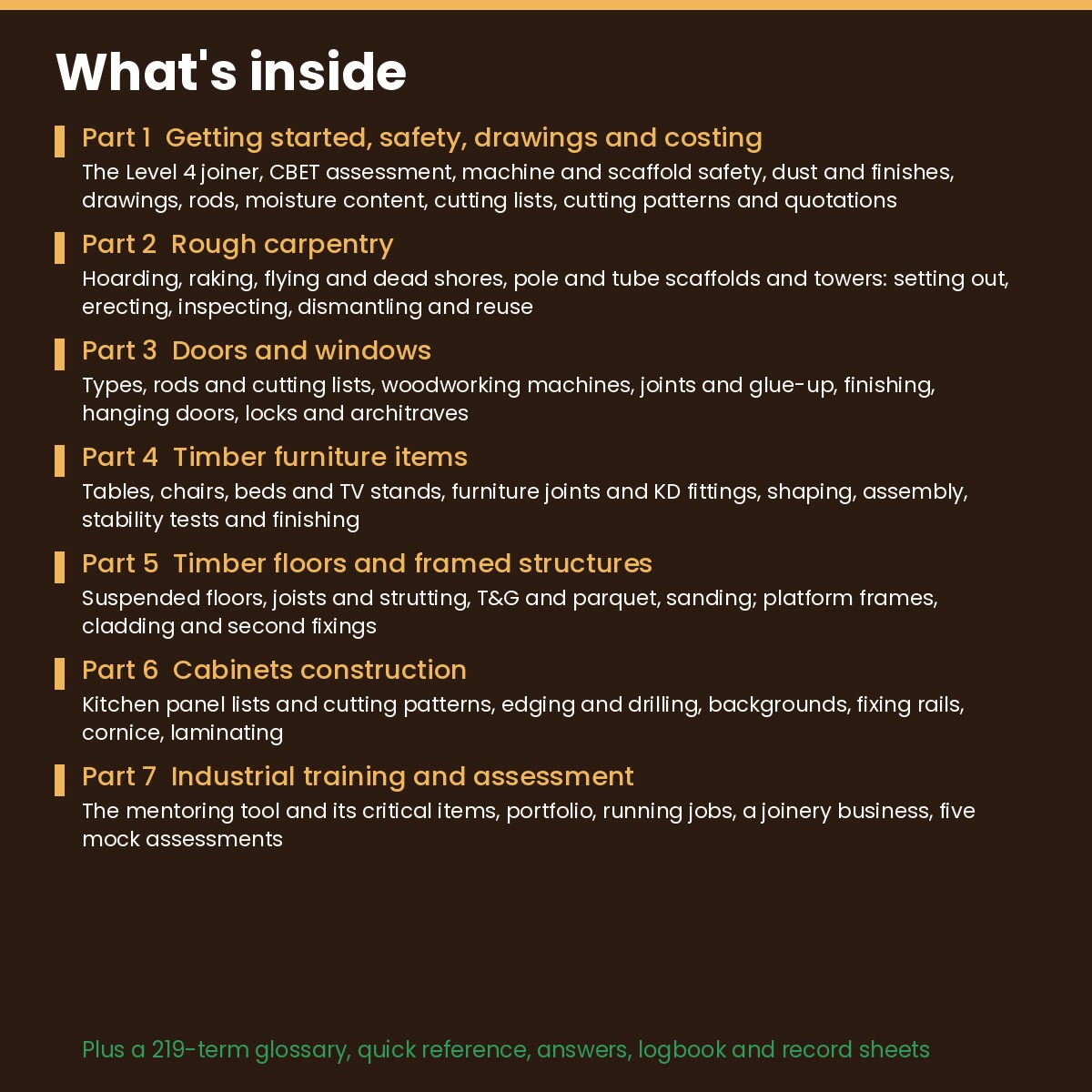
Part 1: Getting Started, Safety, Drawings and Costing – the Level 4 carpenter’s job, CBET assessment and where the marks are, machine and scaffold safety, dust, noise and finishes, green practice and offcut products, working drawings and rods, conversions and timber by the running foot, moisture content and movement, boards, cutting lists, cutting patterns and the costing method the whole book uses.
Part 2: Rough Carpentry (Unit 1) – hoarding, raking, flying and dead shores, pole and tube scaffolds and mobile towers: site survey, setting out, erecting, inspecting, handing over, dismantling in the right order, reuse and pricing.
Part 3: Doors and Windows (Unit 2) – door and window types, leaf sizes, rods and cutting lists, marking out in pairs, the woodworking machines in depth, the mortise-and-tenon family, dovetails, dowels and adhesives, glue-up, finishing timber surfaces, hanging doors, locks and ironmongery, windows and architraves.
Part 4: Timber Furniture Items (Unit 3) – furniture drawings and ergonomic sizes, tables, chairs, beds, TV stands and shoe racks, furniture joints and knock-down fittings, templates and shaping; assembling, testing strength and stability, finishing, pricing and delivery.
Part 5: Timber Floors and Framed Structures (Unit 4) – suspended floors, joists, trimming and strutting, battens on slabs, T&G and parquet floors, sanding and sealing; platform frames, wall panels and openings, raising, cladding, linings and second fixings.
Part 6: Cabinets Construction (Unit 5) – kitchen drawings and panel lists, cutting patterns and yield, cutting out, edging and drilling members, templating and preparing backgrounds, fixing rails, cornice and plinth, laminating worktops and finishing.
Part 7: Industrial Training and Assessment – the mentoring tool and its critical items, the portfolio of evidence, running joinery jobs from site visit to handover, a small carpentry business, and mock assessments for all five units marked like the CDACC tool.
Reference: a 219-term glossary, a quick reference of timber sizes and conversions, moisture targets, sheet sizes, joint proportions, door hardware positions, scaffold reminders and the costing formula, answers with full working to every practice question, and photocopiable logbook, task-record, cutting-list, machine-check and snagging sheets.
Why trainees and trainers like it
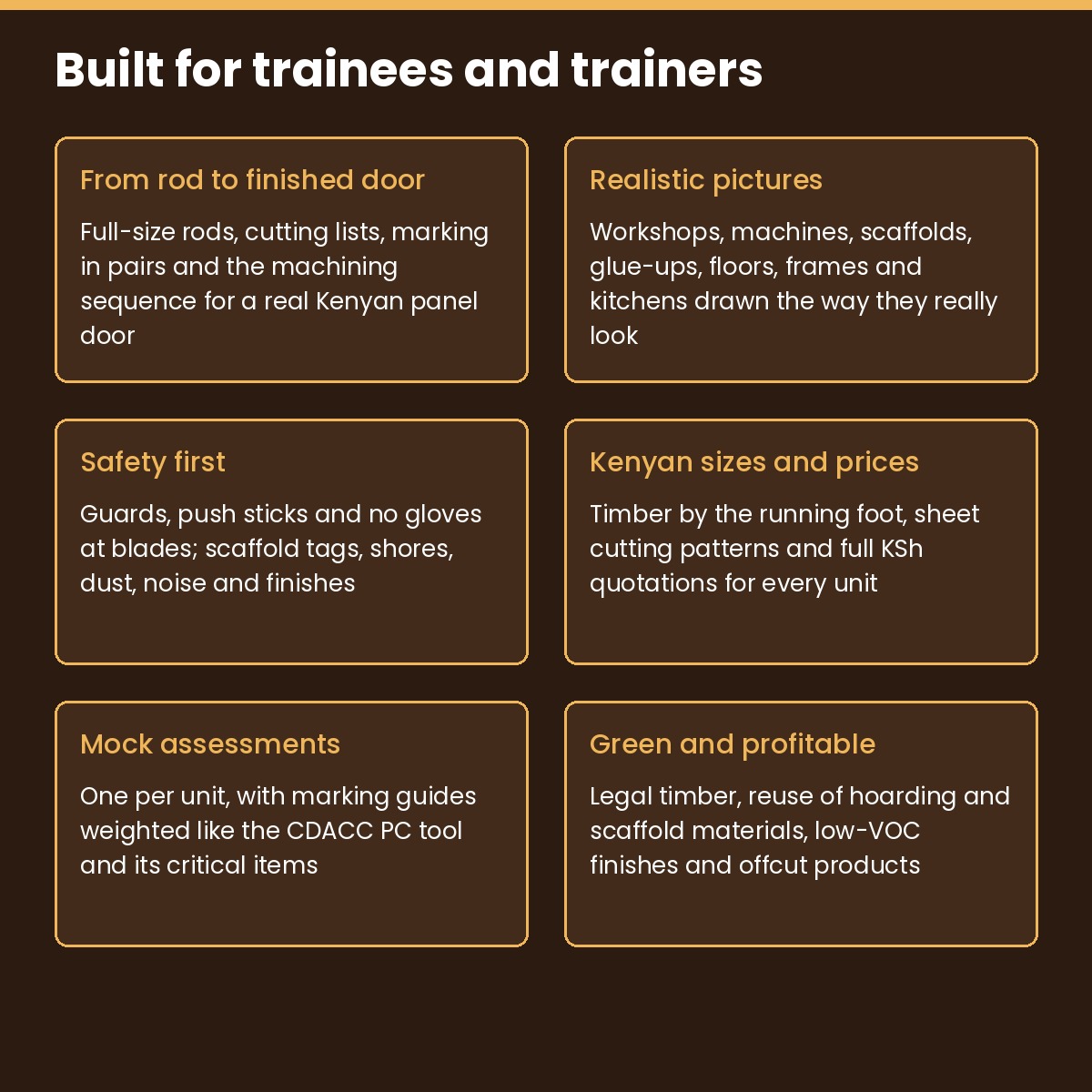
- Follows your curriculum: same units, learning outcomes and hours as the official CDACC Cycle 3 Level 4 curriculum.
- Kenyan practice: timber bought by the running foot, Kenyan boards and prices, the National Building Code 2024 and Kenya Standards for timber and boards.
- Safety first: guards, riving knives and push sticks, no gloves at blades, inspected scaffolds, shores left to the engineer, and protection from dust, noise and solvents.
- Real Kenyan costings: quotations for a hoarding, a back door, a set of doors hung, a dining chair, a TV stand, a floor and a kitchen, all by one clear method.
- Green and profitable: legal timber, reusing hoarding and scaffold materials, low-VOC finishes and turning offcuts into products you can sell.
- Independently checked: the technical content was checked by an independent reviewer, and every worked example and answer was recalculated.
Format and delivery
PDF, A4, 313 pages, full colour. Download instantly after payment (5 downloads allowed, no expiry). Single-user licence: for your own study or teaching, not for resale or sharing. Pay by M-Pesa or card.
This is an independent study guide. It is not published or endorsed by TVET CDACC, TVETA or the Ministry of Education. Always train under a qualified trainer and wear the correct PPE.




Reviews
There are no reviews yet.