
6 min read
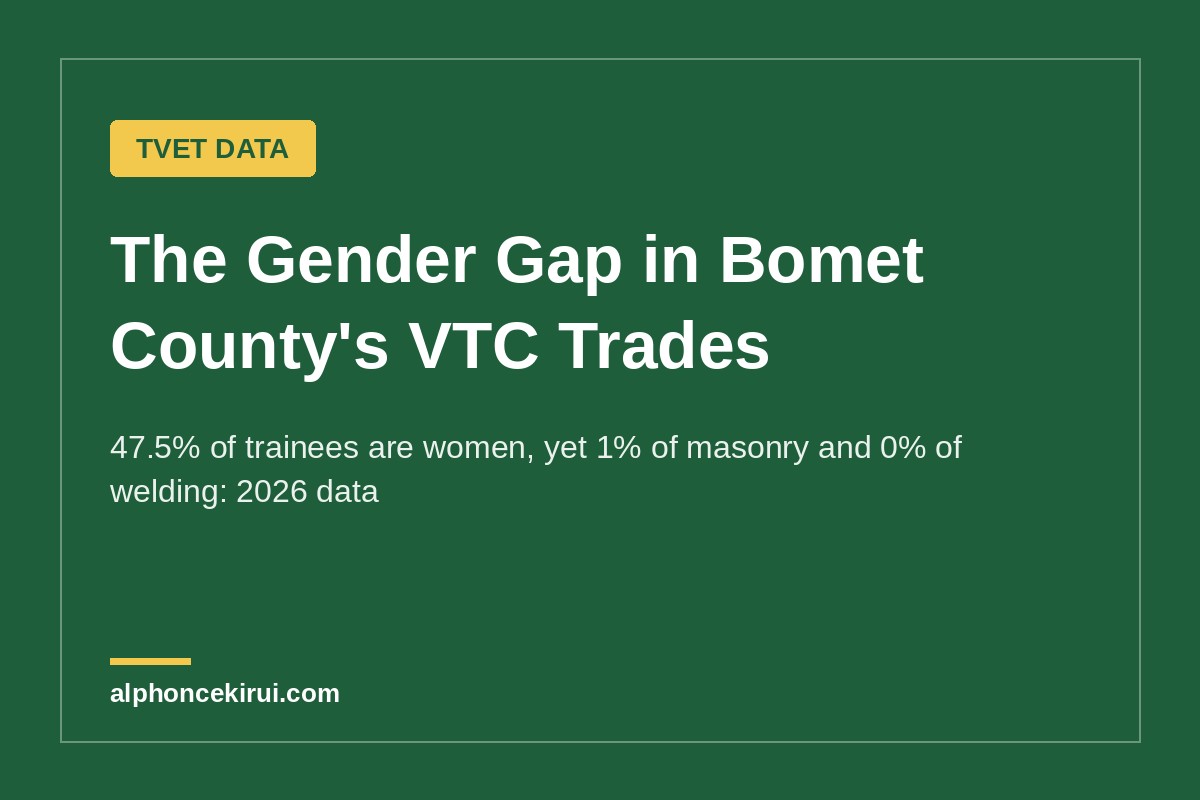
When I compiled the Term 3, 2026 enrolment returns from all 33 Vocational Training Centres in Bomet County, the headline looked like good news: 4,805 trainees, 47.5% of them women. On gender, the county’s VTCs appear almost perfectly balanced.
Look one level down, at the trades people actually choose, and the picture changes completely. This post walks through what the numbers show, why it matters for the young people involved, and what VTCs, parents and employers can do about it. The full data is in the Bomet VTC Enrolment and Staffing Report 2026.
Balanced overall, divided by trade
Here is the share of women in each core trade, from the census:
| Trade | Trainees | % female |
|---|---|---|
| Masonry / Building Technology | 1,089 | 1% |
| Carpentry & Joinery | 273 | 1% |
| Welding | 146 | 0% |
| Motor Vehicle Mechanics | 332 | 6% |
| Electrical Installation | 235 | 9% |
| Panel Beating | 16 | 13% |
| Plumbing | 191 | 17% |
| Motor Vehicle Electronics | 10 | 20% |
| Computer Operator | 163 | 50% |
| ICT Operator | 65 | 72% |
| Food Processing Technology | 184 | 79% |
| Tailoring & Dressmaking | 815 | 89% |
| Fashion Design & Garment Making | 284 | 92% |
| Hairdressing & Beauty Therapy | 995 | 99% |
| Knitting | 16 | 100% |
Group the trades and the split is stark. The eight construction, mechanical, electrical and metal trades together have about 2,290 trainees, and by my estimate from the rounded percentages only around 90 of them, roughly 4%, are women. The hairdressing, tailoring, fashion and knitting classes have about 2,110 trainees, and around 94% of them are women.
In other words, the county is not short of women in training. It is short of women in half of the trades, and short of men in most of the other half. Only Computer Operator comes out evenly split.
Why it matters
For young women
The trades where women are almost absent are the ones that feed construction sites, garages, electrical contractors and fabrication workshops: work found in every town in the county. Building is the biggest trade in our VTCs, with over a thousand trainees, yet roughly one in a hundred is a woman. A young woman who never considers masonry, welding or electrical installation has quietly lost half of her options before she enrols.
For young men
The same is true in reverse. Hairdressing and beauty, with nearly a thousand trainees, has about one man in a hundred. Tailoring and fashion are similar. Young men are filtering themselves out of trades where many can make a living close to home.
For the trades themselves
When almost everyone in a class is the same gender, the next generation of instructors and employers will be too, and the pattern repeats. It also concentrates competition: three trades (masonry, hairdressing and tailoring) already make up 60% of core-trade enrolment, while higher-value trades such as Motor Vehicle Electronics (10 trainees) and Panel Beating (16) barely exist.
Where the gap comes from
The census counts who enrols; it does not record why. But the pattern is consistent across the county’s 33 centres, which points to choices made before a trainee ever reaches a VTC: what families expect, what friends are doing, which trades young people have seen someone like them practise, and what they believe a workplace will accept. A girl who has never seen a woman wire a house, or a boy who has never seen a man run a salon, is unlikely to picture himself or herself doing it.
What can change it
None of these needs a large budget. Most of them are about what young people and parents see before and during enrolment.
- Show the full menu at admission. When a new trainee comes to enrol, walk them and their parent through every trade the centre offers, with what each leads to, before asking for a choice. My guide on how to choose a trade at a VTC is written for exactly that conversation.
- Use role models people can see. A woman electrician, welder or mason invited to an open day or a church or chief’s baraza does more than any poster. The same goes for a successful male barber or tailor speaking to boys.
- Put women instructors in technical workshops. The report names female instructors in technical trades as one of the obvious levers. Where a centre recruits, this is worth weighing.
- Offer short taster sessions. A few hours in the welding bay or the salon in the first week lets trainees try a trade before they commit to it.
- Make the first trainees feel safe and welcome. The first two or three women in a masonry class, or men in a hairdressing class, need a centre that takes teasing and exclusion seriously. Once a few succeed, others follow.
- Ask employers for mixed attachment places. Industrial attachment is part of the CDACC courses. Contractors and garages that accept women trainees for attachment open a door that the classroom alone cannot. My industrial attachment guide explains what a placement involves.
- Keep counting. Collecting enrolment by trade and gender every term is what made this picture visible. Centres that track their own numbers can see whether their efforts are working.
For parents and young people reading this
Every trade in a Kenyan VTC is open to women and men alike, and the CDACC assessment is the same for everyone: you are judged on whether you can do the work safely and to standard. If a trade interests you, the fact that few people like you are in it today is not a barrier. It may even help you stand out. Free revision pages for each trade are on the CDACC hub, and experienced workers without certificates can read about recognition of prior learning.
A note on the data
The figures come from returns submitted by the Principals of all 33 VTCs and corrected up to 1 October 2026. Counted by trade, trainees total 4,814, nine more than the 4,805 counted by year of study, because some returns do not yet add up exactly. Computer Operator and ICT Operator were added to the form late, so their numbers are probably understated. The group totals above are my own estimates from the report’s rounded percentages. The full report has the method and every centre’s numbers.
Key points
- Bomet’s 33 VTCs are 47.5% female overall, but trade choice is sharply divided by gender.
- Women are about 1% of masonry and carpentry trainees and 0% of welding; men are about 1% of hairdressing trainees.
- Across eight technical trades, roughly 4% of trainees are women; across four beauty and garment trades, roughly 94% are women.
- Low-cost levers: the full trade menu at admission, visible role models, women instructors in workshops, taster sessions, welcoming first trainees, mixed attachment places, and tracking the numbers.
Published in a personal capacity. The data belongs to the Directorate of Vocational Training, County Government of Bomet, and is used with permission; the interpretation is mine.
Trainer Toolkit: Ready-to-Use Assessment Templates
Seven working templates for competency-based assessment, from the assessment plan to candidate feedback.
- Assessment plan and observation checklist
- Oral questioning and product checklists
- Decision record and feedback form (PDF)
Enter your email and the download opens straight away. You will also get occasional practical tips; unsubscribe anytime.
Resources for trainers
Study guides and AI prompts built for CDACC Cycle 3. Pay with M-Pesa and download instantly.
-
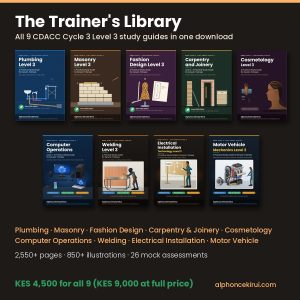
Trainer’s Library: All 9 CDACC Cycle 3 Level 3 Study Guides (PDF Bundle)
KSh 4,500.00 Add to cart -
Sale!

Fashion Design Level 4 Study Guide (CDACC Cycle 3) – PDF Ebook
Original price was: KSh 1,200.00.KSh 900.00Current price is: KSh 900.00. Add to cart -
Sale!

Masonry Level 4 Study Guide (CDACC Cycle 3) – PDF Ebook
Original price was: KSh 1,200.00.KSh 900.00Current price is: KSh 900.00. Add to cart
Leave a Reply