

8 min read
Strategic Focus Areas
The following strategic focus areas have been identified to overcome the challenges and constraints facing the VTC sector in Bomet County.
Governance and Management
Good management can take an organization to greater heights despite challenges by ensuring prudent use of resources. The functionality of any training institution mainly depends on the governance and management structures. It is of critical importance that such structures promote cohesion, nurture accountability and provide visionary leadership necessary to create a conducive learning environment. The County Government Bomet recognizes the need for stakeholder involvement in the governance of VTCs.
The structure of governance and management in VTCs should therefore aim to encourage cooperation and collaboration of all stakeholders for effective representation and participation; and enhance democracy, ownership, transparency and accountability, including decentralization and mobilization of local resources. In this regard, the County Government of Bomet, the national government, the community, and the private sector should be fully involved in developing vocational training centres in the spirit of tripartite governance.
Vocational Training Centres should be mainstreamed into the County education structures to enhance integration, vertical and horizontal mobility, participation and life-long learning.
To address the governance and management structures within the vocational training centres, the County Government of Bomet should facilitate the following:
- Establishment of a mechanism for consultation, dialogue and coordination of various stakeholders in the VTC sector.
- Application of principles of good governance and credible reputation with VTC stakeholders.
- Adoption and implementation of the National government particularly TVETA criterion for the appointment of Board of Governors.
To implement these, the County Government of Bomet should apply the following strategies:
- Incorporate vocational training centres as semi-autonomous corporate bodies with the power to own, dispose of property, sue and be sued in the corporate name.
- Apply for licensing and registration of vocational training centres following the provisions of the TVETA regulations and other relevant legislation.
- Establish a County Vocational Training Centres Board and other necessary mechanisms for the effective participation of stakeholders in the development, management and coordination of education and training services in the sector.
- The County Executive Committee Member for the time being in charge of Vocational Training shall develop rules and regulations for nomination, the appointment of BOGs and shall appoint Boards of Governors with appropriate stakeholders’ representation.
- Ensure that all persons appointed to the Boards of Governors of VTCs shall be suitably qualified and experienced in education and public affairs or industry, commerce, finance, professional practice and be persons of high integrity as stipulated in the rules and regulations for the appointment of BOMs.
- Ensure management BOGs promote dialogue and participation of staff and students to improve democratic governance.
- Ensure BOGs periodically develop strategic plans, Vocational Centre Integrated Development Plans (VCIDP) and Centre Annual Development Plans (VCADP) with a vision and mission for the Vocational Training Centre.
Human Resource Management
Appropriate human resource capacities and competencies to match the envisaged status of vocational training centres are key in policy considerations. It doesn’t exist at the moment a scheme of service for VTCs technicians, instructors and auxiliary staff.
It is recognized that public image concerns of the vocational training centres are manageable by putting in place mechanisms to address gaps between competencies and the responsibilities of those mandated to provide and manage education and training in the sector.
The need to build the human resource capacities and enhance competencies will be a major responsibility of the County Government of Bomet
To ensure human resource development and management for the vocational training centres, the County Government of Bomet should facilitate the following:
- Integration of qualified and competent staff of Vocational Training Centres within the existing legal framework.
- Collaboration with stakeholders and development partners, in human resource development programmes.
- Development of skills upgrading and in-service programmes for instructors, principals and members of the Board of Management.
To implement these, the County Government of Bomet should apply the following strategies:
- Ensure recruitment of competent personnel who possess appropriate professional skills following the laid down government regulation as outlined in the competitive scheme of service and other relevant legislation.
- Develop and implement criteria for the appointment and appropriate deployment of Vocational Training Centres Principals.
- Ensure efficient and cost-effective utilization of instructors by reviewing and establishing appropriate staffing norms.
Curriculum Implementation and Quality Assurance
Vocational training centres programmes are expected to provide training that promotes horizontal and vertical mobility as well as life-long learning. It is also expected to provide market-focused skills that are responsive to a competitive economy. These institutions shall offer training programmes tailored to the needs of appropriate technology, competency-based evaluation training and resources of the community in which they operate.
Thus, these institutions shall provide technical, entrepreneurial, ICT skills to prepare the youth to take responsibility in production as self-employed or create employment at the local level. The programmes shall also foster the participation of youth and adults especially disadvantaged individuals or persons with special needs thus the need for an appropriate and flexible delivery mechanism is important.
The high level of performance and productivity demanded by the competitive economic environment requires close collaboration between training institutions and employers. The new global training demands multi-skilling and competence-based skills.
Skills recognition, assessment and certification are important components of training and skills development. They serve as a check to training providers and testing and certification agencies.
To ensure quality and relevant training VTCs, the County Government of Bomet should facilitate the following:
- Approved curriculum implementation in all VTCs.
- Entrenching entrepreneurship, life skills and ICT programmes in VTCs.
- Comply with the systems of assessment of competencies to promote mobility and linkages for entry and re-entry into the system.
- Encouraging the culture of innovation and creativity in VTCs
To implement these, the County Government of Bomet should apply the following strategies:
- Improving the Vocational Training Centres to enable them to offer training programmes within the mainstream technical education and training system.
- Rationalizing training programmes offered in the VTCs to provide market-responsive training that meets the needs of different target groups and the socio-economic needs of immediate communities.
- Undertaking an audit of the tools, equipment and infrastructure development programme for financing
- Identify suitable courses to respond to labour market needs locally and globally.
- Developing business training programmes to inculcate entrepreneurial culture in the VTCs trainees.
- Engaging Quality Assurance and Standards (QAS) personnel to monitor and evaluate VTCs to ensure compliance with set standards in the Kenya National Qualification Framework (KNQF).
- Ensure all programmes are assessed internally and externally and certified by recognized Assessment and Certification bodies.
- Developing flexible curriculum delivery mechanisms such as part-time, evening, e-learning and holiday programmes to accommodate a variety of learners.
Infrastructure, tools and equipment.
Our VTCs should be able to adequately impart practical skills to their trainees. Adequate infrastructure, tools and equipment are essential for quality training and a conducive learning environment. The County Government of Bomet should as a matter of priority provide funds for building workshops, Classrooms, offices and buying tools and equipment.
The only way we can save our VTCs from collapsing and compete with other TVET institutions is if our VTCs can produce trainees with enough competencies for the job market, industry and those that the communities need, there will be no shortcut in achieving this without proper hands-on training.
The provision of these facilities and equipment in VTCs has remained a persistent challenge. The condition of the majority of VTCs is deplorable due to lack of electricity, poor access roads and inadequate and unreliable water supply. The obsolete or non-functional tools and equipment jeopardize the quality of training. There is limited budgetary allocation at the moment for developing and upgrading infrastructure and acquiring tools and equipment for Bomet County VTCs.
The planning and development of VTCs shall be following the provisions of the National and County Acts.
To ensure the provision of adequate infrastructure, tools and equipment in VTCs the County Government of Bomet should facilitate the following:
- Acquisition of land ownership documents for vocational training centres.
- Provision of adequate and appropriate infrastructure and equipment in vocational training centres.
- Provision of guidelines for security and insurance for infrastructure, tools and equipment.
- Provide guidelines, implement and encourage the culture of maintenance of infrastructure, tools and equipment.
- Collaboration with other relevant county departments, national government, development partners, private sector, parastatals, and other stakeholders to target VTCs in development programmes such as access roads, rural electrification, and communication and water services.
- Mobilization of resources, rehabilitation and support of the VTCs.
- Promotion of investment and use of alternative sources of energy and appropriate technology.
- Development of appropriate physical infrastructure for students with special needs.
- Provision of recreational, sports and games facilities.
To implement these, the County Government of Bomet should apply the following strategies: –
- Work in partnership with parents, communities, private sector, national government, CDF fund managers and other development partners in the provision of adequate infrastructure, tools and equipment.
- Encourage the VTCs trainees to participate in recreation and sporting activities by organizing sports and games within and outside the county.
- Develop and systematically implement an infrastructure modernization programme to match the changing training needs.
- Develop and implement equipment maintenance and replacement programmes to be responsive to technological change.
- Introduce the use of alternative sources of energy such as solar energy, bio-mass and windmills in Youth Polytechnics
- Collaborate with the relevant government ministry and agencies to ensure that VTCs are targeted in rural electrification programmes.
Trainer Toolkit: Ready-to-Use Assessment Templates
Seven working templates for competency-based assessment, from the assessment plan to candidate feedback.
- Assessment plan and observation checklist
- Oral questioning and product checklists
- Decision record and feedback form (PDF)
Enter your email and the download opens straight away. You will also get occasional practical tips; unsubscribe anytime.
Resources for trainers
Study guides and AI prompts built for CDACC Cycle 3. Pay with M-Pesa and download instantly.
-
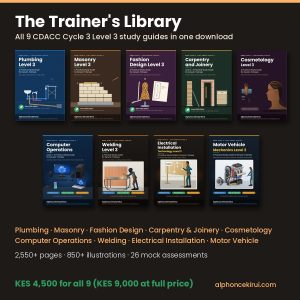
Trainer’s Library: All 9 CDACC Cycle 3 Level 3 Study Guides (PDF Bundle)
KSh 4,500.00 Add to cart -
Sale!

Plumbing Level 4 Study Guide (CDACC Cycle 3) – PDF Ebook
Original price was: KSh 1,200.00.KSh 900.00Current price is: KSh 900.00. Add to cart -
Sale!

Welding Level 4 Study Guide (CDACC Cycle 3) – PDF Ebook
Original price was: KSh 1,200.00.KSh 900.00Current price is: KSh 900.00. Add to cart
Leave a Reply