
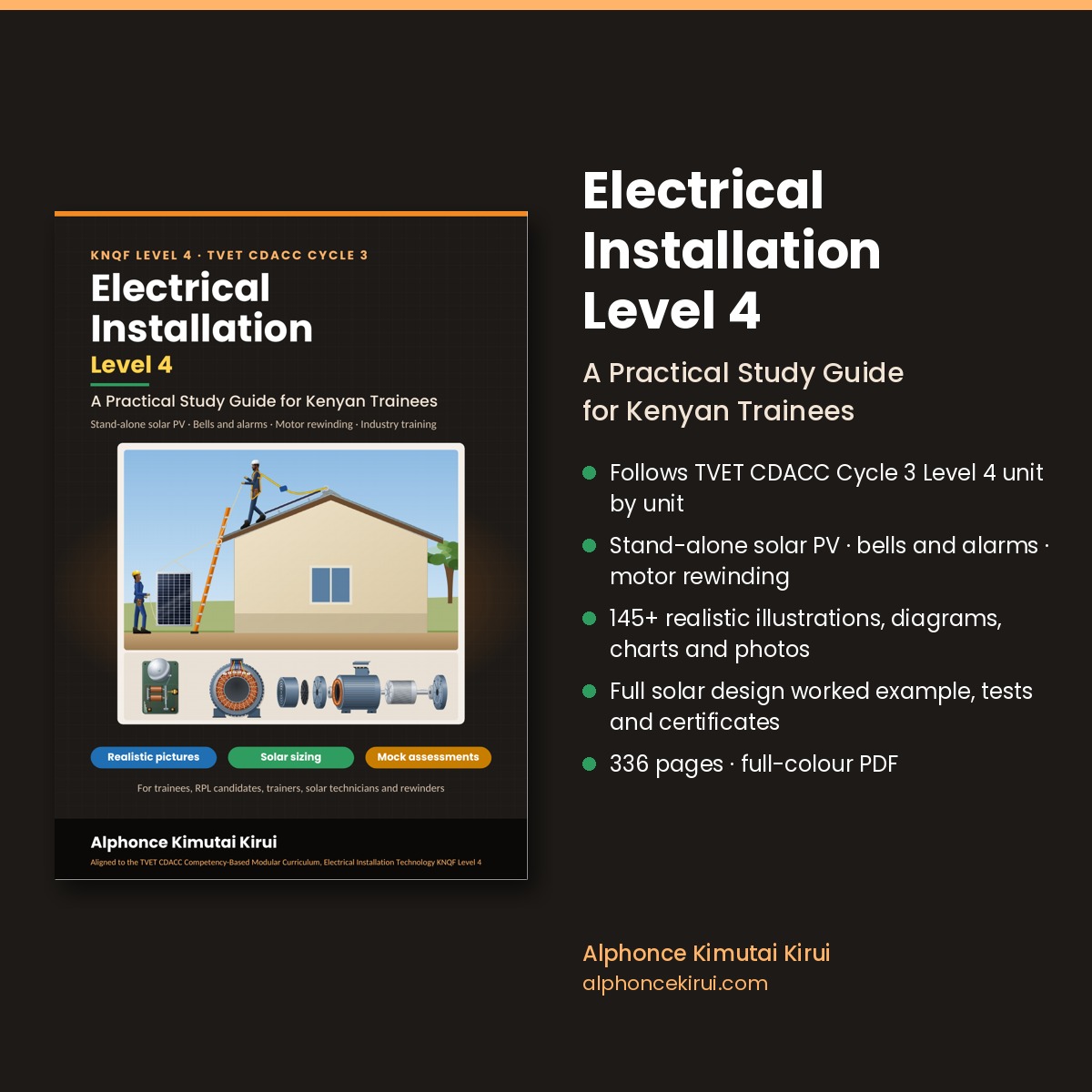
This free revision page is for VTC and technical college trainees and RPL candidates preparing for the CDACC Electrical Installation Level 4 (Electrical Installation Technology) assessment. Level 4 covers three core units plus at least 320 hours of industry training. The three Level 3 units of the qualification (PVC sheathed cable, trunking and conduit) are covered in a companion Level 3 guide.
Units and hours
| Unit of competency | Hours | What you must be able to do |
|---|---|---|
| Stand-Alone Solar PV Systems | 120 | Size, mount, wire, earth, test, commission and maintain an off-grid solar system |
| Bell and Alarm Installation | 120 | Install, test and maintain bell, intruder and fire alarm circuits |
| Electrical Machine Winding | 120 | Dismantle a motor, record winding data, rewind the stator, reassemble and test it |
| Industry training (attachment) | 320 (minimum) | Apply the three units at a workplace under a mentor, with a logbook and portfolio |
Key notes by unit
Stand-Alone Solar PV Systems
- A module makes voltage whenever light falls on it. Isolate, lock off and prove dead with a DC-capable tester first.
- Array size (W) = daily energy (Wh) × 1.3 ÷ peak sun hours. Size on the cloudy months.
- Fit the battery fuse in the positive, close to the battery terminal. DC breakers and fuses must be DC-rated: a DC arc does not go out by itself.
- Connect the battery to the controller before the PV array, so the controller senses the system voltage. Never run an inverter from the LOAD terminals.
- Insulation test: below 120 V use 250 V DC (minimum 0.5 MΩ); 120–500 V use 500 V DC (minimum 1 MΩ).
Bell and Alarm Installation
- Bell pushes run at extra-low voltage from a safety isolating transformer (e.g. 4–8–12 V) on a fused spur.
- Segregate ELV alarm cables from 240 V cables (own conduit or trunking compartment).
- Intruder loops are closed-circuit, so a cut wire raises an alarm. Fit the end-of-line (EOL) resistor at the last device.
- Typical zone readings: about 4.7 kΩ normal, open circuit = alarm, near 0 Ω = tamper or short.
- Standby battery (Ah) = (standby current × 24 h + alarm current × alarm time) × 1.25.
Electrical Machine Winding
- Synchronous speed Ns = 120 × f ÷ p; the rotor always runs slightly slower (slip).
- Before stripping, record nameplate, slots, coils, spans, turns, wire size and connection on a data sheet.
- Before varnishing, test continuity, resistance balance (within ±5%), insulation (500 V DC, at least 5 MΩ) and polarity.
- A 400 V Y / 230 V Δ motor goes in star on 415 V; in delta its windings burn out.
- Fit bearings with a heater or press on the inner ring, never by hammering.
Practice questions
A home uses 375 Wh a day at a site with 5.0 peak sun hours. What array size is needed?
Answer: 375 × 1.3 ÷ 5.0 = 97.5 W, so one 100 W module.
Why must a solar battery fuse be near the battery positive terminal?
Answer: Cable between the battery and the fuse is unprotected against short-circuit currents of hundreds of amperes or more.
An installer uses an AC MCB as a PV isolator. What is wrong?
Answer: It may not break a DC arc and can weld or burn. Fit a DC-rated 2-pole isolator.
A 1,500 W inverter (90% efficient) runs on 24 V. Minimum battery fuse?
Answer: Current = 1,500 ÷ (0.9 × 24) = 69.4 A; 1.25 × 69.4 = 86.8 A, so a 100 A DC-rated fuse.
A panel draws 0.18 A standby for 24 h and 0.9 A for 30 minutes in alarm. Battery size?
Answer: 4.32 + 0.45 = 4.77 Ah; × 1.25 = 5.96 Ah, so a 7 Ah battery.
An intruder zone reads 0.3 Ω at the panel. What does this mean?
Answer: The cores are shorted or the EOL resistor is bypassed: tamper or fault.
Why must the alarm devices and EOL resistors be disconnected before an insulation test?
Answer: The test voltage can destroy the electronics, and the devices make the reading falsely low.
A 4-pole, 50 Hz motor: what is its synchronous speed?
Answer: Ns = 120 × 50 ÷ 4 = 1,500 rev/min.
After rewinding, phase resistances read 3.10, 3.05 and 3.35 Ω. Is the winding acceptable?
Answer: No. Phase W is 5.8% above the 3.167 Ω average, outside ±5%. Check its joints before varnishing.
On assessment day, what do you do just before switching on a system you have installed?
Answer: Test, record the readings and switch on only with the assessor’s permission.
Common mistakes in the assessment
- Treating formative assessments as practice: they count for 60% of the unit score.
- Studying theory alone. Theory carries only 10% and is asked orally while you work.
- Ignoring critical items in the mentoring tool: a high total does not help if one is not met.
- Filling the attachment logbook from memory at the end instead of daily.
- Believing the certificate is a licence: solar work needs an EPRA licence, so work under a licence holder.
Safety essentials
- A solar system is not dead because the inverter is off: the array and battery are still live.
- Remove rings, watches and bracelets before working on batteries.
- Ventilate lead-acid batteries low-in, high-out: hydrogen is explosive at about 4% in air.
- Tie ladders at the top, set 1 out for 4 up, and clip the lanyard to a roof anchor, never the gutter.
- Warn occupants before testing a fire alarm sounder.
Get the full guide
The full guide has about 350 pages in 16 chapters: worked calculations, practical tasks, competence checklists, 12 practice questions per chapter with worked answers, mock assessments, quick-reference tables and logbook pages. Get the complete Electrical Installation Level 4 guide or read the free sample first.
Revision offer: buy any 2 CDACC study guides and use code REVISION2 at checkout for KES 300 off. Valid until 15 December 2026.
This is an independent study guide. It is not published or endorsed by TVET CDACC, TVETA or the Ministry of Education.