
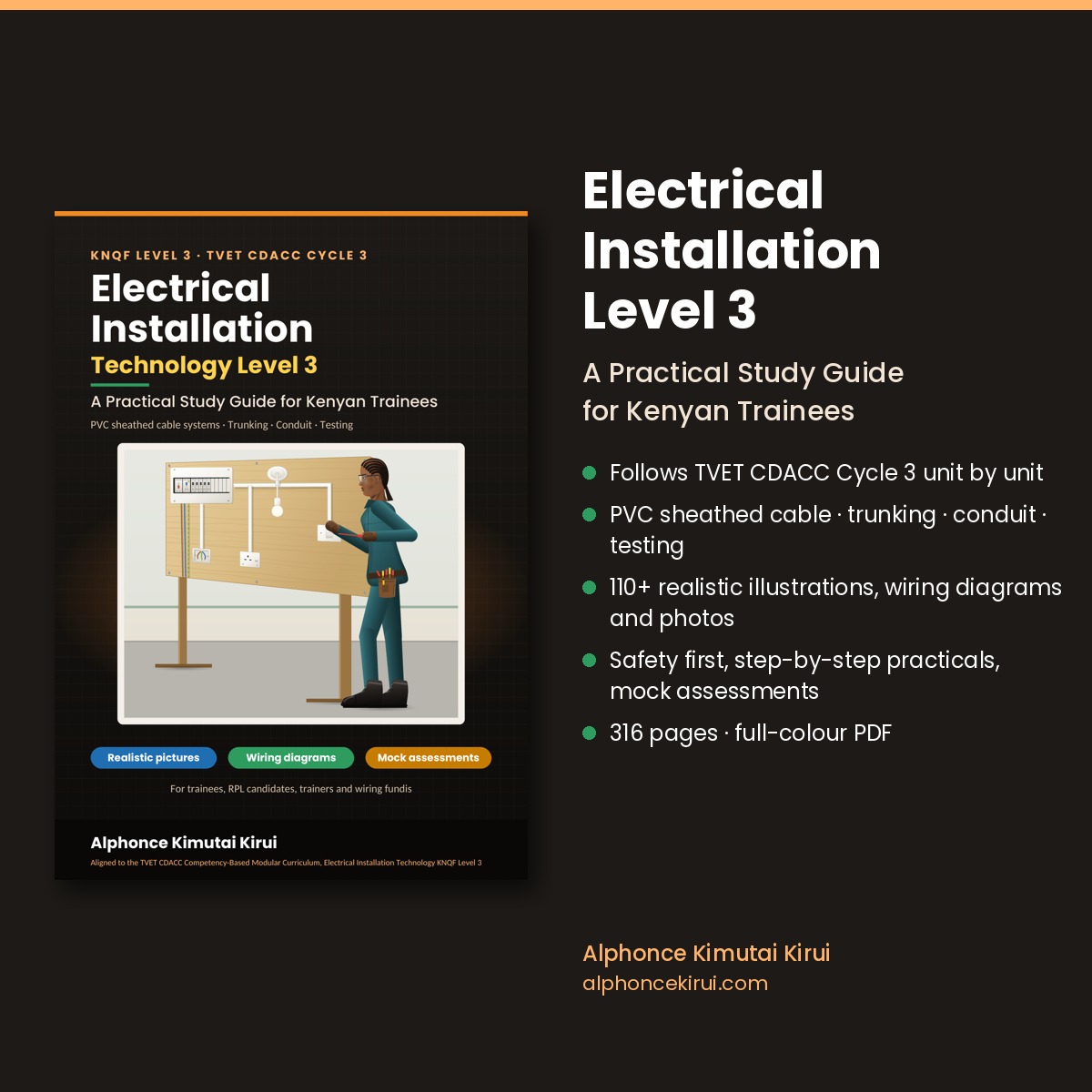
This free revision page is for trainees and RPL candidates preparing for the CDACC Electrical Installation Level 3 assessment (Electrical Installation Technology, KNQF Level 3). The course has three core units, each teaching one wiring system for single-phase installations, plus industry training. Assessment is 90% practical with oral theory questions, and each unit score is 60% formative plus 40% summative.
Units and hours
| Unit of competency | Hours | What you must be able to do |
|---|---|---|
| PVC Sheathed Cable System Installation | 100 | Make joints, draw diagrams, install the intake point and final circuits, then inspect and test |
| Trunking System Installation | 100 | Measure, cut and mount trunking, lay cables and fix accessories |
| Conduit System Installation | 100 | Cut, thread and bend conduit, mount it and draw in cables |
| Industry training | 240 (minimum) | Work under a mentor and keep a logbook and portfolio |
Key notes by unit
PVC Sheathed Cable System Installation
- Colours: brown line, blue neutral, green-and-yellow CPC (old: red line, black neutral).
- Lighting: 1.5 mm² on a 6 A Type B MCB. Radial sockets: 2.5 mm² on 20 A. Cooker: 6 mm² on 32 A.
- The switch always goes in the line; every point gets a CPC.
- Shallow-buried cables stay in the safe zones (150 mm below the ceiling, 150 mm from a corner, or in line with an accessory) and need 30 mA RCD protection.
- TT earthing: rod of 1.2 m or longer, 10 mm² earthing conductor, aim for 10 Ω or less, never above 200 Ω.
Trunking System Installation
- Common sizes: 16 × 16, 25 × 16, 25 × 25 and 40 × 25 mm. These are not areas, so never write “mm²”.
- Cables may fill no more than 45% of the inside space.
- Mitres: short point = long point − 2 × trunking width.
- Fix within about 50 mm of every end, corner and box; mini-trunking typically at no more than 300 mm.
- Steel trunking needs an earth link at every joint. Never joint cables inside trunking.
Conduit System Installation
- Size is the outside diameter (20, 25 or 32 mm); PVC lengths are about 2.9 m.
- Bend PVC with the matching spring, steel with a bending machine; inside radius at least about 2.5 × diameter. Never heat PVC with a flame.
- Thread steel with oil: half a turn forward, a quarter back.
- Ream every cut end; burrs strip insulation during drawing in.
- PVC conduit needs a separate green-and-yellow CPC in every circuit.
Practice questions
Which cable and MCB suit a lighting circuit?
Answer: 1.5 mm² cable on a 6 A Type B MCB (10 A at most), about 10 points or fewer.
(Oral) List the steps of safe isolation.
Answer: Identify the circuit; switch off and lock off; tag it; prove the tester; test L–N, L–E and N–E; prove the tester again; start work.
Compare radial and ring socket circuits.
Answer: Radial: 2.5 mm², 20 A, up to about 50 m². Ring: 2.5/1.5 mm², 32 A, up to 100 m², a complete loop back to one MCB.
The furthest socket on a 2.5/1.5 mm² radial is 18 m away. Expected R1 + R2? (7.41 and 12.10 mΩ/m)
Answer: 18 × 7.41 + 18 × 12.10 mΩ = 0.133 + 0.218 ≈ 0.35 Ω.
Insulation resistance: test voltage and minimum value?
Answer: 500 V DC; at least 1 MΩ. Remove lamps and disconnect dimmers first.
Why add up cable factors before choosing trunking?
Answer: The total must not exceed 0.45 × the inside area (45% space factor).
(Practical) Mitring 25 mm trunking, the long point is 600 mm. Short point?
Answer: 600 − 2 × 25 = 550 mm.
How many right-angle bends are allowed between draw-in points?
Answer: Usually no more than two.
(Practical) Where do saddles go on horizontal 20 mm rigid PVC conduit?
Answer: Within about 150 mm of each box, bend and coupler, the rest at no more than 1.5 m.
Summative 90/120, formative average 80%. Score and rating?
Answer: 0.6 × 80 + 0.4 × 75 = 78%, Proficient.
Common mistakes in the assessment
- Proving dead with a non-contact pen instead of a two-pole voltage indicator.
- Forgetting the N–E test, or writing “OK” instead of the reading.
- Leaving the R1 + R2 link in, or not nulling the leads.
- Running cable diagonally outside the safe zones.
- Rushing measuring and marking, which carry many marks in Units 2 and 3.
- Treating the oral questions lightly.
Safety essentials
- Never work live: isolate, lock off, tag and prove dead.
- Use VDE tools insulated to 1000 V.
- Use CO2 or dry powder on electrical fires, never water.
- Set ladders at 1 in 4 with three points of contact.
- Switch off before touching a shock victim; call 999 or 112.
Get the full guide
The full 316-page guide has 17 illustrated chapters with worked examples, practical tasks and competence checklists, three mock practical assessments, a glossary, a quick reference, answers to every practice question and logbook pages. Get the full Electrical Installation Level 3 guide or read the free sample.
Revision offer: buy any 2 CDACC study guides and use code REVISION2 at checkout for KES 300 off. Valid until 15 December 2026.
This is an independent study guide. It is not published or endorsed by TVET CDACC, TVETA or the Ministry of Education.