

8 min read
Kenya has a strange problem. According to the national RPL Policy Framework, up to 83% of the working population is in the informal sector, and an estimated 92% of young people have skills they gained outside a classroom with no certificate to show for them. Meanwhile, employers and tender committees keep asking for papers.
Recognition of Prior Learning (RPL) is the bridge. I covered the basics in my earlier guide on how skilled workers without certificates can get certified. This article goes one level deeper. It answers the questions candidates and VTC managers ask me most: How long does it take? Who sits on the panel? What is the pass mark? What happens if I fail?
The answers come from TVET CDACC’s own RPL Assessment and Certification Guidelines and the Ministry of Education’s national RPL guidelines. Both date from 2021, so confirm current fees and forms with your assessment centre before you apply.
The four parts of the system, in plain terms
RPL in Kenya is not run by one office. Four groups share the work:
- KNQA (Kenya National Qualifications Authority) sets the national rules, registers qualifications and keeps the record of every qualification awarded through RPL.
- Qualification awarding institutions such as TVET CDACC develop the assessment tools, appoint assessors and issue the certificates.
- Assessment centres, often TVET institutions and VTCs, receive candidates, counsel them, collect fees and host the assessment.
- Industry and employers supply experts for assessment panels and, ideally, help pay for their workers’ assessment.
Why does this matter to a candidate? Because when something goes wrong, you need to know who to talk to. Your first stop is always the assessment centre.
Step by step, with the deadlines
CDACC’s guidelines set clear time limits at each stage. Here is the journey:
- Expression of interest. You fill in a screening form at an assessment centre. The centre must review it and tell you the outcome within five working days. The answer can be: apply for the course you want, apply for a different course, or do skills gap training first.
- Application and counselling. You pay a non-refundable application fee set by CDACC. A registered RPL counsellor then guides you on the learning outcomes and the evidence you need.
- Portfolio screening. A different counsellor from the one who guided you reviews your portfolio of evidence. This must be done within seven working days. You are either registered for assessment or referred for skills gap training.
- Assessment planning. At least three working days before your assessment, the assessor plans it with you. You should receive the occupational standard, a summary of the learning outcomes, the assessment rules and the appeal procedure. You and the assessor both sign the plan.
- Final assessment. This can include written or oral tests, practical tasks, a project, a presentation, or observation at work.
- Results and certification. CDACC validates the results unit by unit and issues the certificate.
That second-counsellor rule in step 3 is worth noticing. It exists to stop the person who helped you build your portfolio from also being the one who approves it.
Who assesses you
Practical tests and oral tests are run by a panel of three, all appointed by CDACC:
- a trainer who is a subject specialist,
- an industry expert who is a subject specialist, and
- an RPL expert, such as a CDACC, Ministry or quality assurance officer, who guides the process.
If the trainer’s and the industry expert’s marks differ by more than 10, the RPL expert steps in to harmonise them. Written tests are supervised by one assessor for up to 25 candidates.
Two details matter for many Jua Kali artisans. Translation is allowed for Level 3 and Level 4 courses. And you get immediate feedback after oral and practical assessments, so you are not left guessing for weeks.
Assessors themselves must meet a bar: a qualification at least one level higher than the course, training in RPL assessment, and at least three years as a trainer or industry practitioner.
The pass marks
The RPL guidelines weight theory and practical differently at each level, with a pass mark of 50% throughout:
| KNQF level | Theory | Practical | Pass mark |
|---|---|---|---|
| 3 | 20% | 80% | 50% |
| 4 | 30% | 70% | 50% |
| 5 | 40% | 60% | 50% |
| 6 | 50% | 50% | 50% |
For candidates with special needs, the pass mark is 40% at all levels.
The lesson is simple. At Levels 3 and 4, your hands earn most of the marks. At Level 6, you need to explain the theory as well as you do the work. A seasoned fundi going for Level 6 should prepare for that.
Note that CDACC’s newer 2025 modular curricula use their own weightings for regular trainees (see CDACC Levels 3 to 6 Explained), so ask your centre which rules apply to your RPL assessment.
What you can be awarded
There are two kinds of CDACC certificate through RPL:
- a National Certificate, when you show competence in every unit of a qualification, and
- a Certificate of Competency, for one unit or a cluster of related units.
This is the point worth repeating at every RPL information day: the certificates are the same as those given to trainees who went through formal training.
If you are going for a full qualification, your industrial attachment mark is the average of your core unit scores, so years of real work count for you here.
If you fall short: re-assessment
Being declared “not yet competent” is not the end. Under the guidelines:
- You apply for re-assessment using the re-assessment form within 30 days of results.
- You only redo the specific unit, not the whole RPL process.
- You can be re-assessed up to two times per unit. After that, you must take top-up training and update your portfolio first.
- Candidates with special needs have no limit, as long as they keep improving.
- If you apply for re-assessment and then fail to show up without approval, you lose the right to appeal or ask again.
If you disagree: appeals
You can appeal at two points:
- Against the portfolio decision, within seven working days, to the RPL coordinator at your centre. The centre’s decision at this stage is final.
- Against the final assessment result, within 14 working days, to CDACC. The Council must hear and decide it within another 14 working days. Your certificate is held until the appeal is settled.
Attach your original application, the outcome you received, your reasons, and any supporting documents.
Fees: what the rules say, and what they don’t
The guidelines do not fix amounts. CDACC sets the application, assessment and re-assessment fees from time to time. What they do fix:
- All of these fees are non-refundable.
- The assessment fee is paid to the centre, which keeps 40% for assessment costs and sends 60% to CDACC.
The national policy framework also commits government to a financing model, a resource mobilisation strategy and a financial aid plan for applicants from disadvantaged groups. Ask your county and your employer what support exists before you pay out of pocket.
What this means for VTCs and counties
If your VTC wants to become an RPL centre, the path is clear. It must first be accredited by TVETA, then registered with CDACC, which gives it access to the RPL portal. Its counsellors, assessors and verifiers apply to CDACC separately.
For counties, the opportunity is large. Every county has hundreds of masons, welders, mechanics and stylists working without papers. A VTC that runs RPL for them, with gap training in its workshops, brings those workers into the formal economy and brings income to the centre.
Three things I would do first:
- Get two or three trainers registered as RPL counsellors and assessors in your strongest trades.
- Hold information days where the workers are: markets, jua kali sheds, bus parks.
- Ask employers and the county to sponsor assessment fees for their workers, as the guidelines intend.
The bottom line
RPL is not a shortcut. It is a full assessment with a three-person panel, clear deadlines and real pass marks. That is exactly why the certificate carries the same weight as one earned in class. If you have the skills, the system now has a route to prove it. Know the rules, build a strong portfolio, and hold your centre to the timelines.
Preparing a portfolio or revising for your assessment? My CDACC Cycle 3 study guides cover nine Level 3 trades unit by unit.
Key takeaways
- Centres must review an expression of interest within 5 working days and screen a portfolio within 7.
- Practical and oral assessments are run by a three-person panel: trainer, industry expert and RPL expert.
- The pass mark is 50% at every level, or 40% for candidates with special needs; the practical share falls from 80% at Level 3 to 50% at Level 6.
- RPL certificates are the same as those earned through formal training.
- You can be re-assessed up to twice per unit; apply within 30 days.
- Appeal a final result within 14 working days; CDACC must decide within 14 more.
- Fees are set by CDACC, are non-refundable, and the assessment fee is split 60% to CDACC and 40% to the centre.
Trainer Toolkit: Ready-to-Use Assessment Templates
Seven working templates for competency-based assessment, from the assessment plan to candidate feedback.
- Assessment plan and observation checklist
- Oral questioning and product checklists
- Decision record and feedback form (PDF)
Enter your email and the download opens straight away. You will also get occasional practical tips; unsubscribe anytime.
Resources for trainers
Study guides and AI prompts built for CDACC Cycle 3. Pay with M-Pesa and download instantly.
-
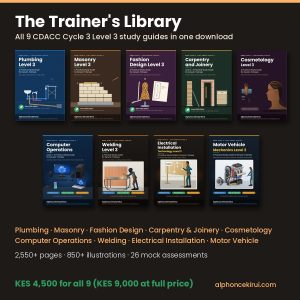
Trainer’s Library: All 9 CDACC Cycle 3 Level 3 Study Guides (PDF Bundle)
KSh 4,500.00 Add to cart -
Sale!
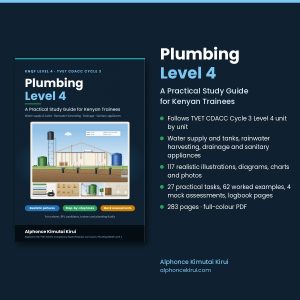
Plumbing Level 4 Study Guide (CDACC Cycle 3) – PDF Ebook
Original price was: KSh 1,200.00.KSh 900.00Current price is: KSh 900.00. Add to cart -
Sale!
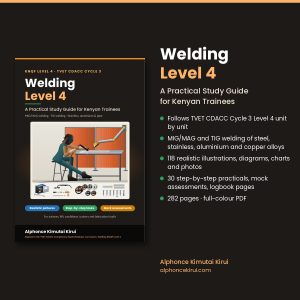
Welding Level 4 Study Guide (CDACC Cycle 3) – PDF Ebook
Original price was: KSh 1,200.00.KSh 900.00Current price is: KSh 900.00. Add to cart
Leave a Reply