
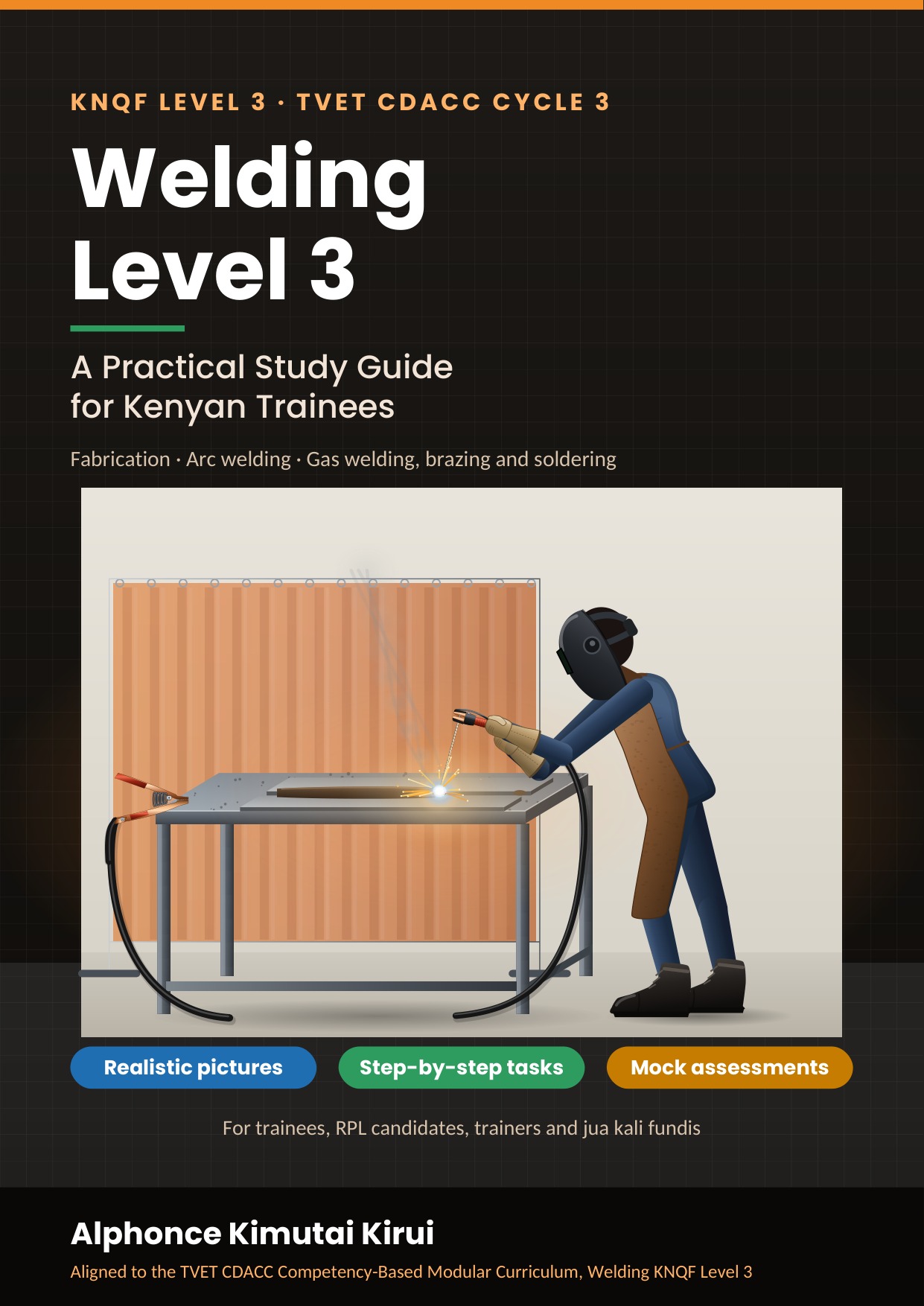
Description
Pass Welding Level 3 with confidence
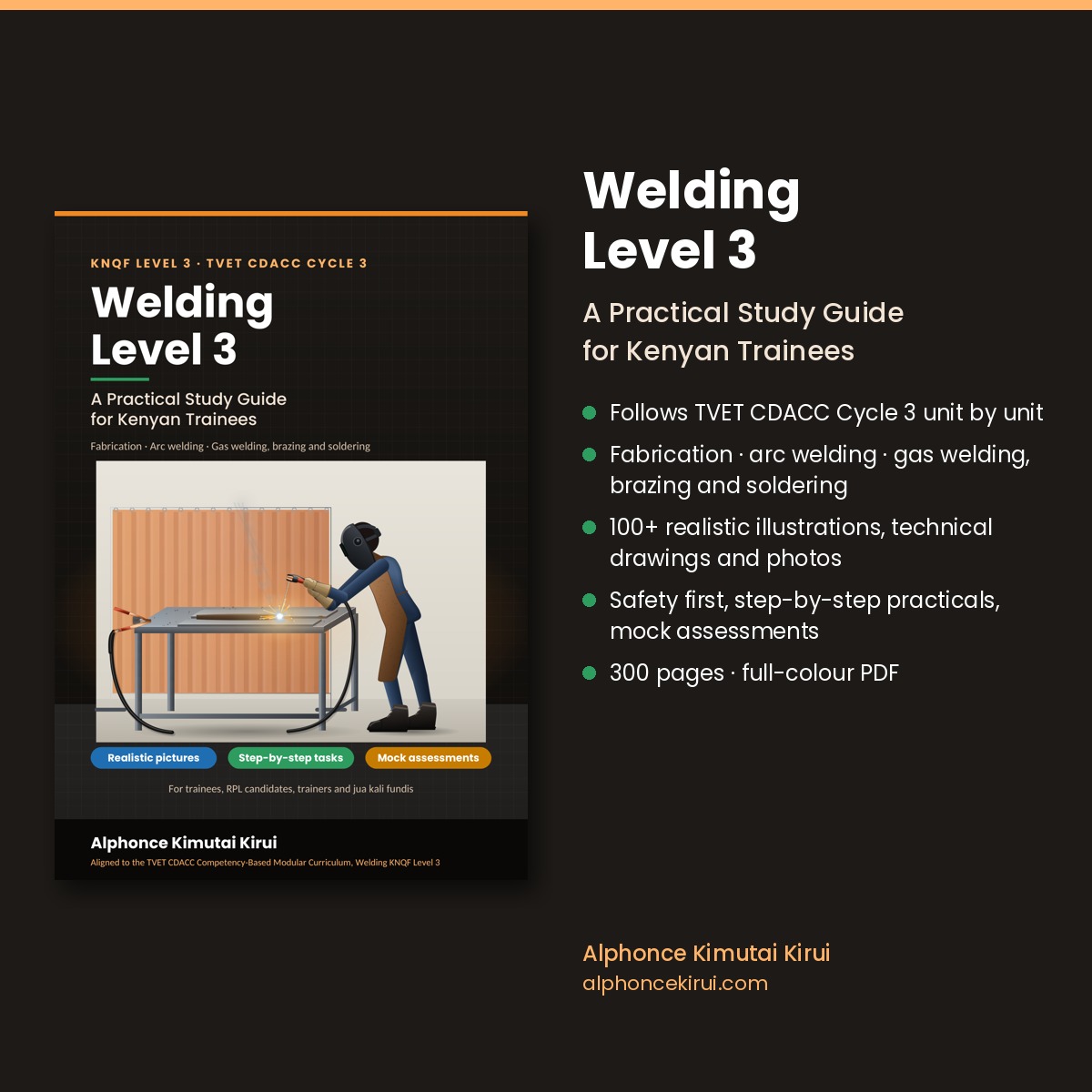
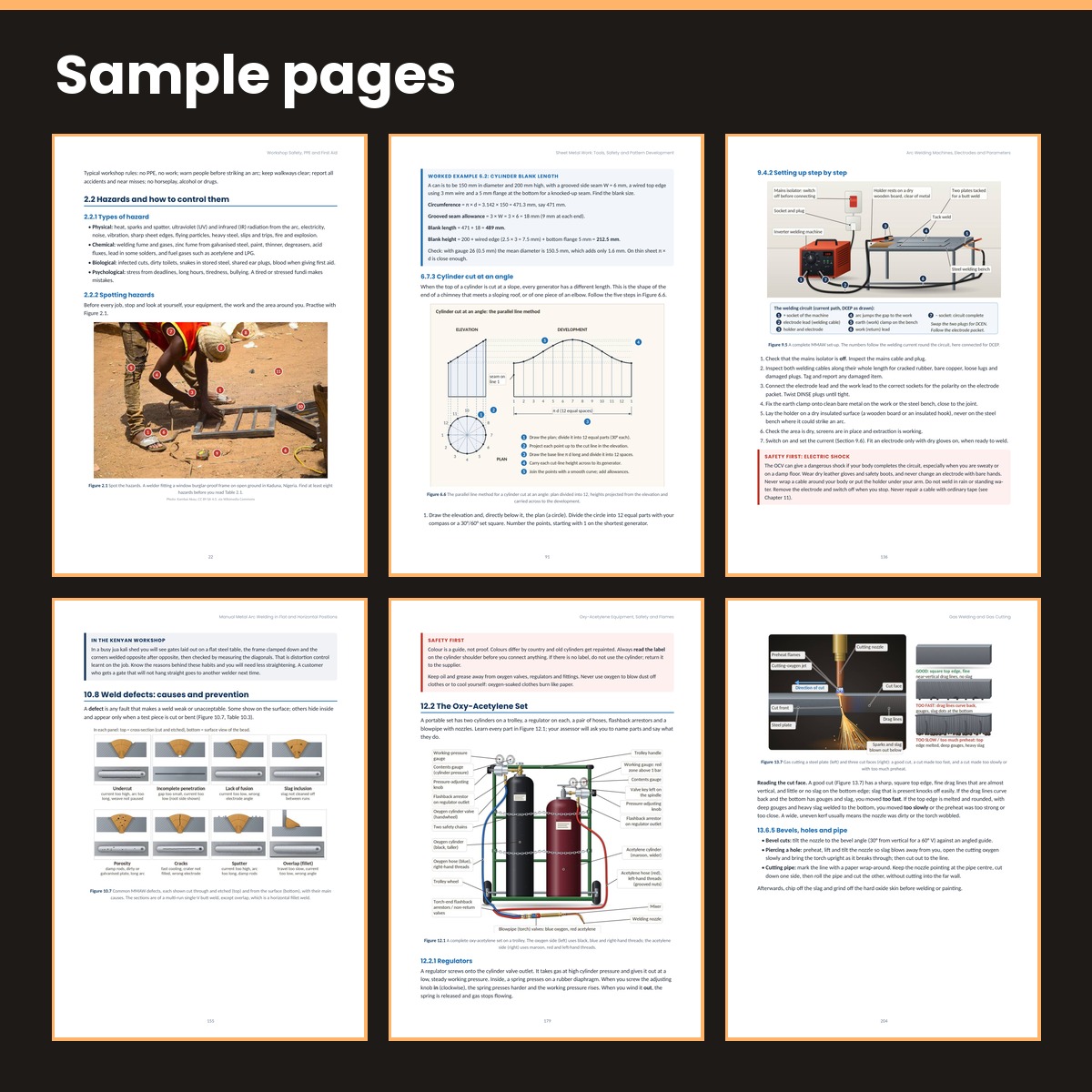
Welding Level 3: A Practical Study Guide for Kenyan Trainees takes you through the whole TVET CDACC Welding (Welder) Level 3 course (Cycle 3, programme 0715 254A) in the order you are trained and assessed. Every chapter is built around a learning outcome, written in plain English for KCPE-entry trainees, and illustrated with realistic pictures: a welder in full PPE, inverter and transformer machines, electrode angles, weld beads and defects, oxy-acetylene sets and flames, sheet metal developments, and real Kenyan products such as gates, window grills and tank stands.
Not sure yet? Download the free sample (36 pages): the front matter, Chapter 1 and the full Chapter 10 on manual metal arc welding in the flat and horizontal positions.
Who is this book for?
- Level 3 trainees in vocational training centres, technical colleges and polytechnics
- RPL candidates (jua kali fundis) preparing for CDACC assessment
- Trainers who need ready-made explanations, practical tasks, worked examples and mock assessments
- Anyone starting in welding and fabrication who wants to work safely and to a professional standard
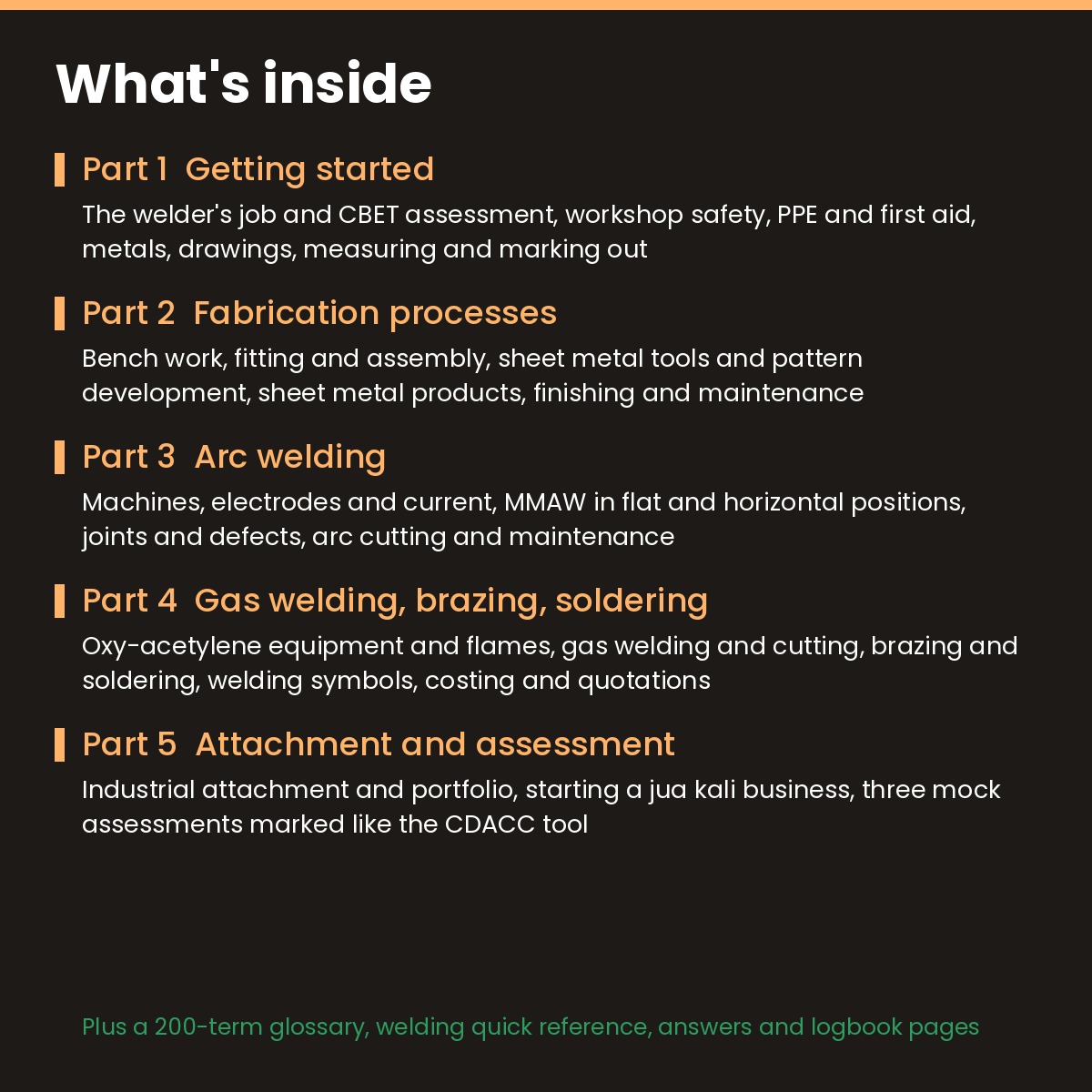
What’s inside
Part 1: Getting Started – the welder’s job and CBET assessment, workshop safety, PPE, shade numbers and first aid, metals, drawings, measuring and marking out.
Part 2: Fabrication Processes I (Unit 1) – bench work tools and operations, fitting and assembly up to 6 mm, sheet metal tools and the parallel line method of pattern development, sheet metal products, surface finishing and maintaining fabrication tools.
Part 3: Arc Welding Processes I (Unit 2) – welding machines, electrodes and current settings, manual metal arc welding in the flat and horizontal positions, weld joints, defects and distortion, arc cutting and maintaining arc welding equipment.
Part 4: Gas Welding, Soldering and Brazing (Unit 3) – oxy-acetylene equipment, cylinder safety and flames, gas welding and gas cutting, brazing and soldering, welding symbols, costing and quotations, and maintaining gas equipment.
Part 5: Industrial Attachment and Assessment – the mentoring tool and portfolio of evidence, starting a small fabrication business, what assessors look for, and a mock practical assessment for every unit with a mark checklist weighted like the CDACC tool.
Reference: a 200-term glossary, a welding quick reference (currents, shades, gas settings, defects, steel sizes and masses, formulas, symbols), answers to every practice question, and photocopiable industrial attachment logbook pages.
Why trainees and trainers like it
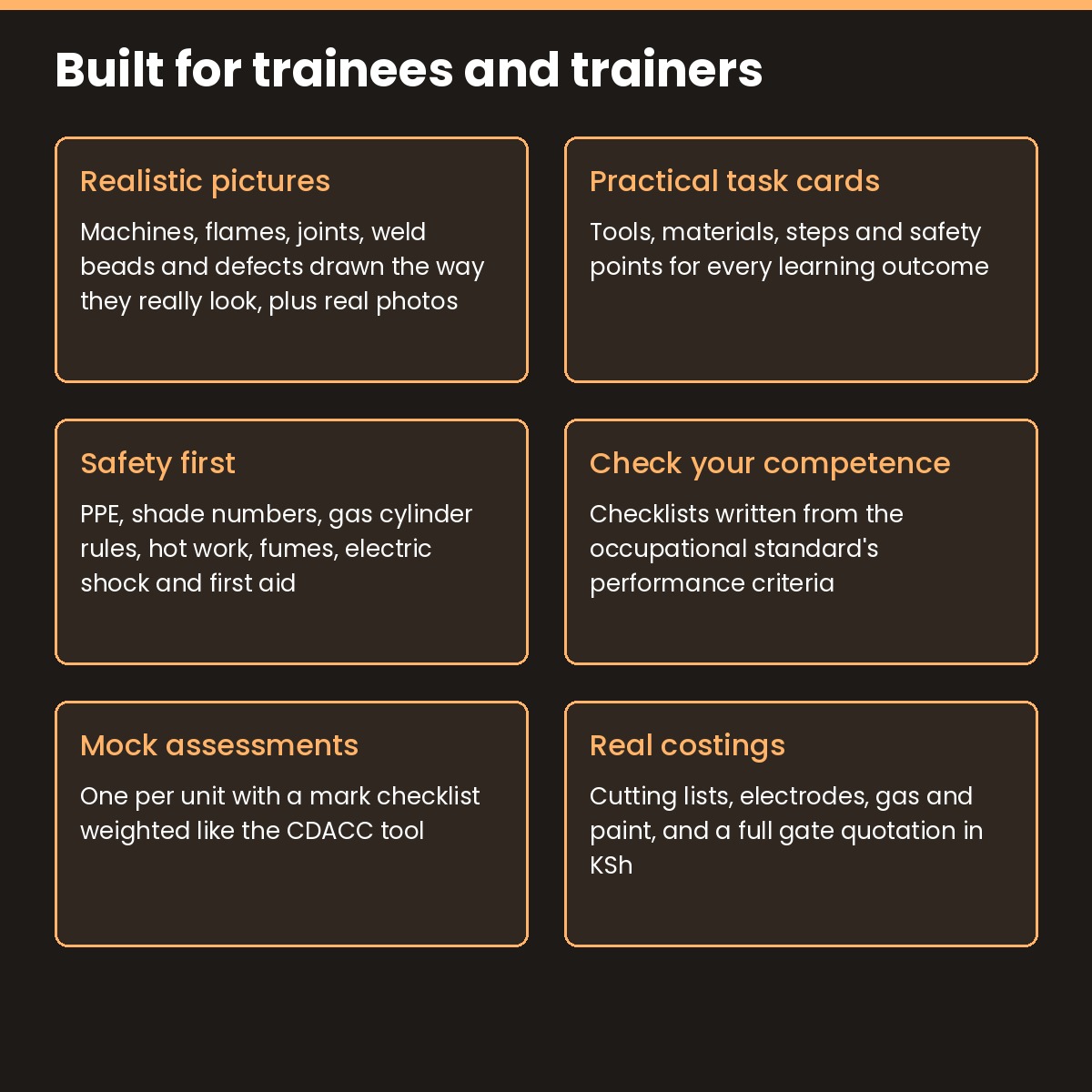
- Follows your curriculum: same units, learning outcomes and hours as the official CDACC Cycle 3 curriculum and occupational standard.
- Realistic pictures: 100+ illustrations, technical cut-aways and photos, so you can see exactly what correct work looks like.
- Safety first: PPE, arc radiation, fumes, electric shock, hot work and gas cylinder rules in every chapter.
- Real Kenyan costings: cutting lists, electrodes, gas, paint and a full gate quotation in KSh.
- Assessment ready: competence checklists, 160 practice questions with answers, and three mock assessments.
Format and delivery
PDF, A4, 300 pages, full colour. Download instantly after payment (5 downloads allowed, no expiry). Single-user licence: for your own study or teaching, not for resale or sharing. Pay by M-Pesa or card.
This is an independent study guide. It is not published, endorsed or approved by TVET CDACC, TVETA or the Ministry of Education. Always train under a qualified trainer with the correct PPE.

Reviews
There are no reviews yet.