
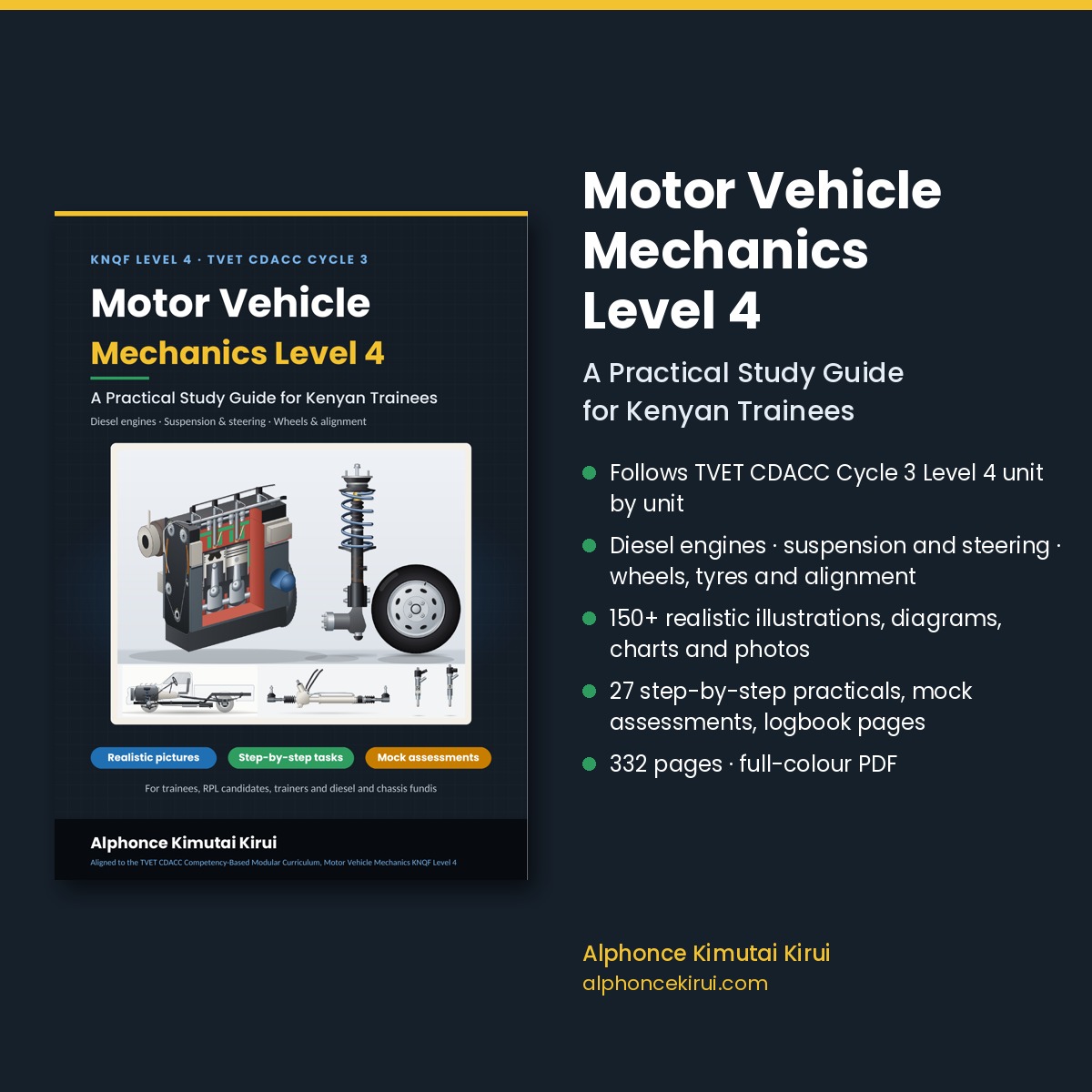
This free revision page is for VTC trainees and RPL candidates preparing for the CDACC Motor Vehicle Mechanics Level 4 assessment. It covers the diesel engine unit, the suspension and steering unit (which includes wheels, tyres and alignment) and the industrial attachment; the Level 3 units, petrol engine and braking, are covered in a companion Level 3 guide. Theory is asked orally inside the practical, the unit score is 60% formative and 40% summative, and 50 is the pass mark.
Units and hours
| Unit of competency | Hours | What you must be able to do |
|---|---|---|
| Maintain Vehicle Diesel Engine | 180 | Diagnose, overhaul and time a diesel engine, and service its cooling, lubrication and fuel systems. |
| Maintain Vehicle Suspension and Steering System | 160 | Diagnose chassis and electronic faults, service suspension and steering, and maintain wheels, tyres and alignment. |
| Industrial attachment | 320 (minimum) | Work in an automotive workplace, assessed by a mentor with the CDACC mentoring tool. |
Key notes by unit
Maintain Vehicle Diesel Engine
- A diesel draws in air only, compresses it to about 1/14 to 1/23 of its volume and injects fuel near TDC; the hot air lights the fuel.
- Diagnose in order: listen, confirm, look, scan, test, find the cause, repair, verify and report.
- Compression is typically 24–34 bar, cylinders within about 10%. Never do a wet test; use a leak-down test.
- Smoke: black means too much fuel or too little air, blue means oil, white means unburnt fuel or coolant.
- Piston protrusion decides the head-gasket grade; head bolts go from the centre outward in torque and angle stages; valve clearances are set cold.
- Pop-test mechanical injectors for opening pressure, seat tightness, chatter and spray; check common-rail injectors with the scan tool and a back-leak test.
Maintain Vehicle Suspension and Steering System
- Steering free play is typically about 30 mm or less at the rim.
- Play at 12 and 6 o’clock points to bearings, ball joints or kingpins; at 3 and 9 to steering joints.
- A healthy CAN bus reads about 60 Ω. C-codes are chassis faults, U-codes network faults.
- Tighten bushes at ride height and U-bolts diagonally in stages. Count threads before changing a tie-rod end.
- Tread wear indicator (about 1.6 mm) is the absolute limit. Repair tubeless tyres from inside with a plug-patch, tread centre only.
- Positive camber is top out; positive castor is axis top rearward; toe-in is fronts closer. Adjust rear, castor, camber, then toe.
Practice questions
Why is a wet compression test never done on a diesel?
Answer: The clearance volume is so small that oil can fill it and lock the piston, bending a rod. Use a leak-down test instead.
A six-cylinder diesel reads 30, 29.5, 30.5, 22, 21.5 and 30 bar. Which cylinders fail the 10% rule, and why?
Answer: Minimum = 30.5 − 3.05 = 27.45 bar, so cylinders 4 and 5 fail. Two neighbours low together point to a head gasket blown between them, or a crack.
What does blue exhaust smoke mean on a diesel?
Answer: Oil is burning.
How is a mechanical injector’s seat tightness checked on the pop tester?
Answer: Hold the pressure 1–2 MPa below opening pressure for 10 seconds; the tip must stay dry.
A 400 mm steering wheel has 12° of free play. Does it pass a 30 mm limit?
Answer: π × 400 × 12 ÷ 360 = 41.9 mm, so it fails.
CAN high to CAN low reads 120 Ω with the battery off. What does this mean?
Answer: It should read about 60 Ω; 120 Ω means one terminating resistor, or its wiring, is open.
Scenario: a raised front wheel rocks at 12 and 6 o’clock. How do you find the worn part?
Answer: Have a helper hold the brake and rock again. If the play disappears it is the wheel bearing; if it stays, the ball joint (or kingpin).
Calculate the overall diameter of a 265/65 R17 tyre.
Answer: 431.8 + 2 × 172.25 = 776.3 mm.
A trammel reads 1,530 mm at the front of the tyres and 1,526 mm at the rear. Is it within 0 to +3 mm?
Answer: No: 1,526 − 1,530 = −4 mm, which is 4 mm toe-out.
Formative average 66, summative 58. What is the unit score and rating?
Answer: 0.6 × 66 + 0.4 × 58 = 62.8: Competent.
Common mistakes in the assessment
- Thinking theory does not count because there is no written paper.
- Leaving wheels, tyres and alignment until last.
- Ignoring the scan tool: electronic diagnosis carries more marks than wheels and tyres.
- Writing readings without units or the specification beside them.
- Answering “why” questions with one word instead of the reason.
Safety essentials
- Injected diesel can pierce skin: find leaks with card, never your hand. An injection injury is a surgical emergency.
- Never work under a vehicle held only by a jack; use stands rated above the load each carries.
- Deflate multi-piece wheels fully and inflate them only in a cage.
- Diesel fires are Class B: foam, CO2 or dry powder, never water. No ether on engines with glow plugs or intake heaters.
- Hand waste to NEMA-licensed handlers; never pour, bury or burn it.
Get the full guide
The full guide has 15 chapters and over 330 pages, with worked calculations, practical tasks with record sheets, two mock assessments, a quick-reference table, answers to the practice questions and logbook pages. Get the full Level 4 guide or read the free sample.
Revision offer: buy any 2 CDACC study guides and use code REVISION2 at checkout for KES 300 off. Valid until 15 December 2026.
This is an independent study guide. It is not published or endorsed by TVET CDACC, TVETA or the Ministry of Education.