
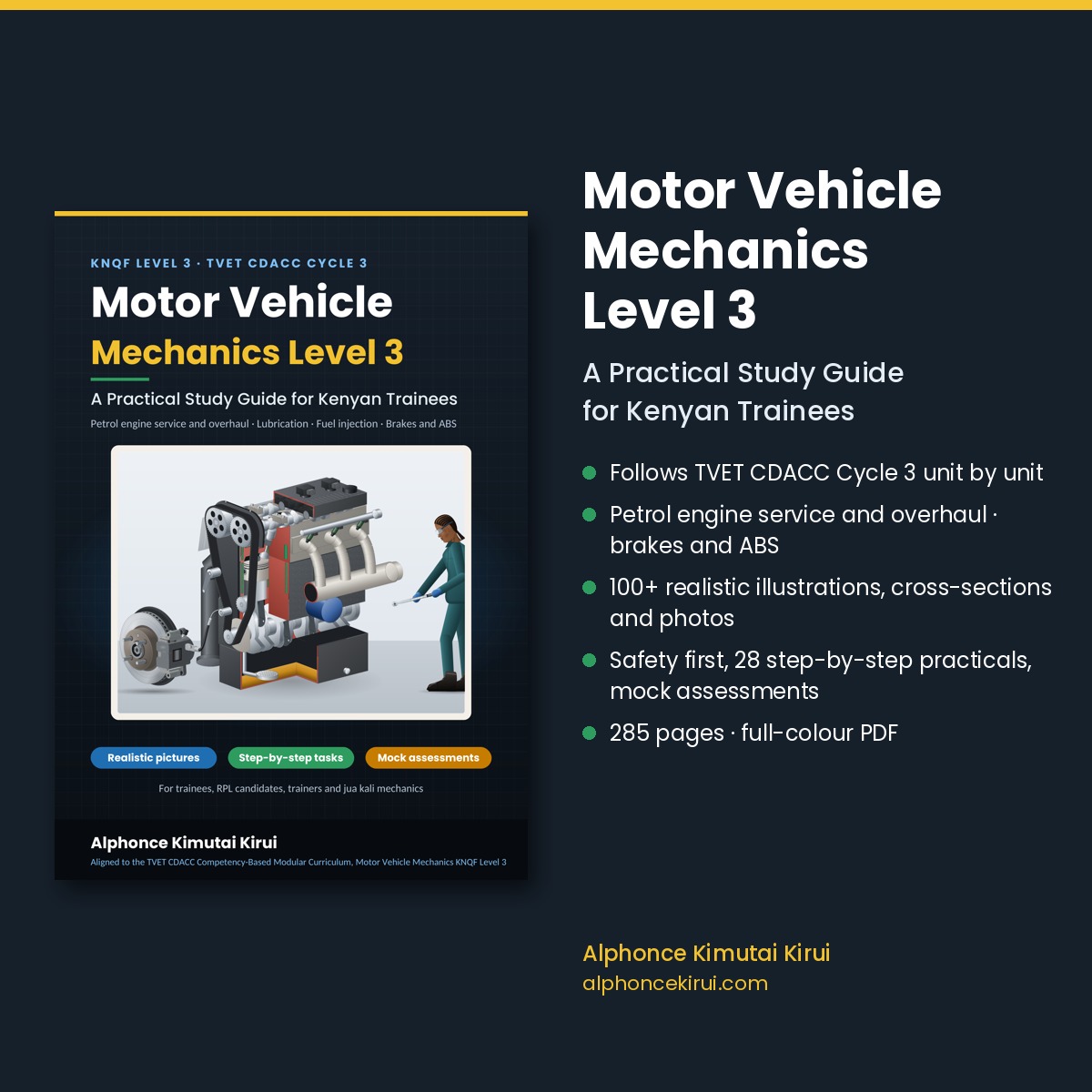
This free revision page is for VTC trainees and RPL candidates preparing for the CDACC Motor Vehicle Mechanics Level 3 assessment. It covers the two core units, petrol engine and brakes, plus industrial attachment. Assessment is 90% practical with theory asked orally; formative work counts 60%, the summative 40%, and 50 or above is Competent.
Units and hours
| Unit of competency | Hours | What you must be able to do |
|---|---|---|
| Vehicle Petrol Engine Maintenance | 200 | Service and overhaul a petrol engine, maintain the lubrication and fuel systems, and keep the work area in order. |
| Vehicle Braking System Maintenance | 100 | Assess, service and diagnose hydraulic brakes and ABS, and keep the work area in order. |
| Industrial attachment | 240 (minimum) | Work in a real garage, at least two thirds of the time on engine and brake jobs, with a signed logbook. |
Key notes by unit
Vehicle Petrol Engine Maintenance
- The four-stroke cycle takes 720° of crank rotation; the camshaft turns at half crank speed. The usual inline-four firing order is 1-3-4-2.
- Compression test: warm engine, charged battery, plugs out, throttle wide open. Typical good readings are 1,000–1,300 kPa, all cylinders within 10%. Add about 15 mL of oil to a low cylinder (wet test): a big rise means worn rings; no rise means a valve or head gasket.
- Smoke colour: blue means oil burning, black a rich mixture, thick white coolant.
- Oil flows sump, strainer, pump, relief valve, filter, galleries, bearings and head, then back to the sump. The filter bypass valve feeds the bearings if the filter blocks.
- Loosen head bolts from the ends inwards, cold and in stages; tighten from the centre outwards. Never reuse torque-to-yield bolts, gaskets, seals, rings or shells.
Vehicle Braking System Maintenance
- Brakes turn energy into heat by friction; too much heat causes fade. Air in the fluid makes the pedal spongy.
- Use the DOT fluid on the reservoir cap (usually DOT 4) from a sealed bottle, change it every two years, and never mix DOT 5 with glycol fluids.
- Check discs for thickness against MIN TH and run-out (typical limit 0.05 mm); drums for diameter against MAX DIA, ovality and bell-mouthing.
- Replace pads and shoes in axle sets, grease slider pins with high-temperature brake grease, and work on one drum brake at a time.
- Diagnosis follows seven steps: ask, verify, look and scan, test, repair, verify, report. With the ABS lamp on, ABS is off but normal braking remains.
Practice questions
What rating does a unit score of 69 get?
Answer: Proficient (65–79). Competent is 50–64; Attained Mastery is 80–100.
Why is a compression test done with the throttle wide open?
Answer: So the cylinders fill fully with air; a closed throttle gives low readings.
A low cylinder rises only 10 kPa on the wet test. What is the likely fault?
Answer: Not the rings: a valve not sealing (burnt, bent or no clearance) or a leaking head gasket.
What does a milky dipstick tell you?
Answer: Coolant is getting into the oil, often through a failed head gasket.
How do you depressurise a fuel system before opening a line?
Answer: Remove the fuel pump fuse or relay, run the engine until it stalls, crank 2–3 seconds more, switch off, disconnect the battery negative and wrap a rag round the joint.
What does the oil pressure relief valve do?
Answer: It limits the maximum oil pressure in the system.
Which wheel do you bleed first on a right-hand-drive car, and why?
Answer: Usually rear left, the wheel farthest from the master cylinder, then rear right, front left, front right, unless the manual says otherwise.
How do you test a vacuum brake booster?
Answer: Engine off, pump the pedal 4–5 times, hold medium pressure and start the engine. The pedal should drop slightly; if not, check the hose, check valve or booster.
What do the C and the 0 in code C0035 mean?
Answer: C is chassis (brakes or ABS); 0 means a generic SAE code. Still look up the exact meaning in the manual.
After a pad change, one front brake drags. What was probably missed?
Answer: The slider pins were not freed and greased, so the caliper sticks.
Common mistakes in the assessment
- Starting work before the vehicle is chocked and on axle stands.
- Quoting a specification from memory. If unsure, say you would check the manufacturer’s manual, then do it.
- Taking readings without recording them or comparing them with the specification.
- Skipping the final test: no leak check, pedal check or oil pressure reading.
- Clearing an ABS code without finding why it was set.
- Leaving tools and waste lying around; housekeeping carries 30 marks in each unit.
Safety essentials
- Never work under a vehicle held only by a jack; use axle stands on firm, level ground, with chocks and the handbrake on.
- Carbon monoxide has no colour or smell. Run engines outside, or with doors open and an extraction hose fitted.
- Fight petrol fires with foam, CO2 or dry powder, never water.
- Never blow brake dust off with compressed air; clean it wet.
- Open a cooling system only when cold.
- Hand used oil and other hazardous waste only to NEMA-licensed handlers.
Get the full guide
The full guide has about 285 pages and 15 chapters, with illustrations, worked examples, practical tasks, answered practice questions, two mock practical assessments weighted like CDACC marking, quick-reference values and logbook pages. Get the full guide or read the free sample.
Revision offer: buy any 2 CDACC study guides and use code REVISION2 at checkout for KES 300 off. Valid until 15 December 2026.
This is an independent study guide. It is not published or endorsed by TVET CDACC, TVETA or the Ministry of Education.