
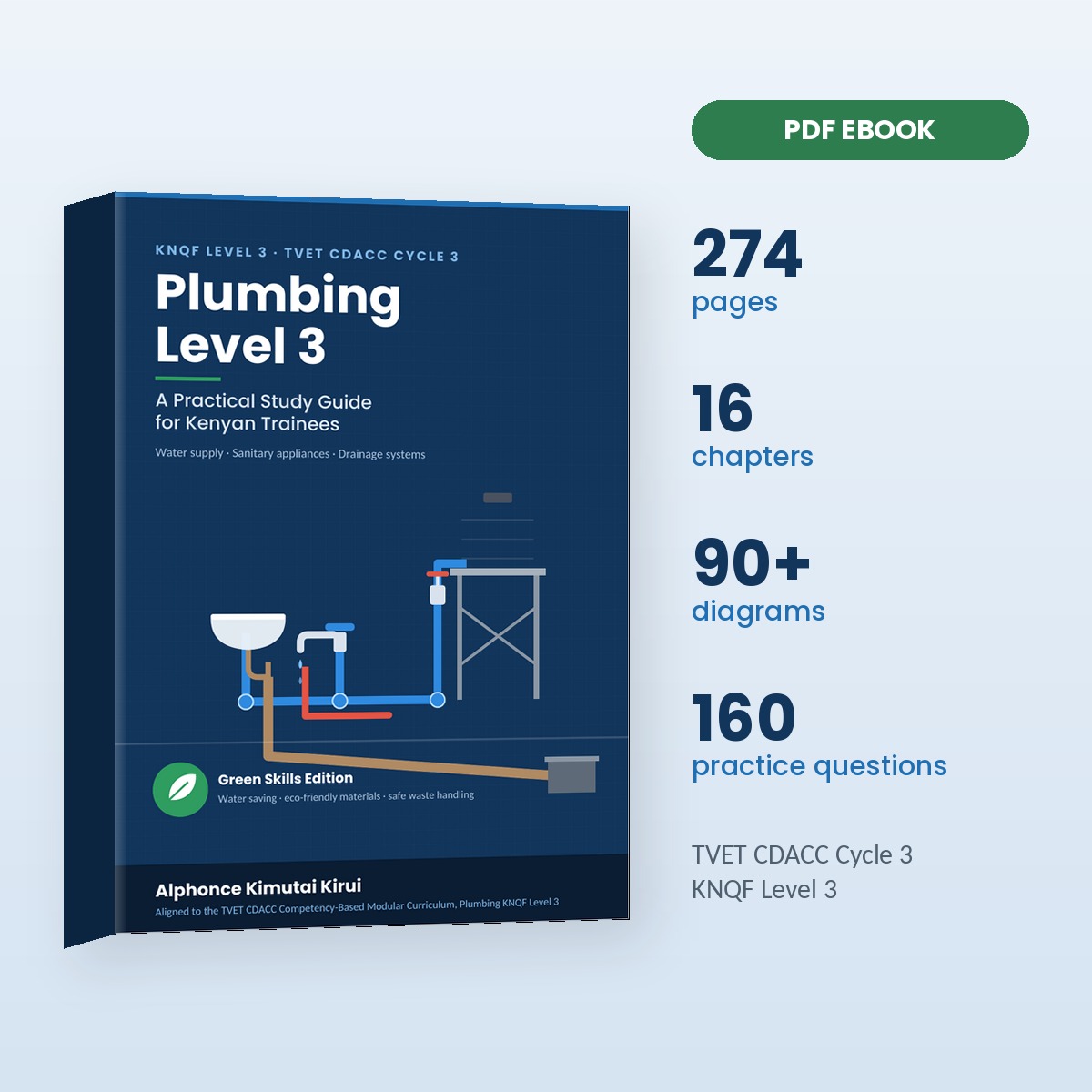
This free revision page is for trainees taking CDACC Plumbing Level 3 (KNQF Level 3, Cycle 3) at a VTC or technical college. The course has three core units (water supply, sanitary appliances and drainage) plus industry training: 540 hours, 54 credits. Each unit is assessed by practical work with oral questions.
Units and hours
| Unit of competency | Hours | What you must be able to do |
|---|---|---|
| Install Water Supply System I | 100 | Prepare materials, sketch pipework, install, test and maintain domestic pipework. |
| Install Sanitary Appliances I | 100 | Prepare, set out, fix, test and repair WCs, basins, sinks, showers and urinals. |
| Install Drainage System I | 100 | Install above- and below-ground drains, read drainage drawings, test and maintain drains. |
| Industry Training | 240 | Work on real jobs under a mentor and keep a signed logbook. |
Key notes by unit
Install Water Supply System I
- PPR is the main pipe inside houses; HDPE serves mains and buried lines; uPVC pressure pipe is for cold water only, kept out of the sun.
- “PN20 Ø25 × 4.2” means 20 bar at 20 °C, 25 mm outside diameter, 4.2 mm wall.
- PPR fusion: cut square, mark socket depth, heat pipe and fitting at about 260 °C, push straight in without twisting, hold still to cool. PPR cannot be solvent-welded.
- Wrap PTFE tape clockwise looking at the end of the male thread.
- Tank connections: float valve inlet, a larger overflow, an outlet about 50 mm above the floor, and a washout.
Install Sanitary Appliances I
- Soil appliances (WC, squat pan, urinal) go to the soil pipe; waste appliances (basin, sink, bath, shower) to waste pipes.
- P traps go into the wall, S traps through the floor; seals are typically 50–75 mm. A squat pan needs a separate trap.
- Typical heights above FFL: WC seat about 400 mm, basin rim 800–850 mm, sink top about 900 mm, urinal rim about 600 mm.
- Fit taps and wastes before mounting a basin; never fully bed a pedestal WC in mortar, as it can crack the pan.
- Hemp and jointing paste are for metal threads only; on plastic use PTFE tape or the supplied washer.
Install Drainage System I
- Usual sizes: basin 32 mm, kitchen sink 40 mm, WC branch 110 mm.
- Fall = length ÷ gradient figure; 1:40 gives 25 mm per metre.
- Air test above ground: about 38 mm water gauge for 3 minutes. Water test below ground: about 1.5 m head, watched for 30 minutes.
- Depth to invert = cover level − invert level.
- Keep a soak pit at least about 30 m from any well, borehole or spring.
Industry Training
- 240 hours and 24 credits, nearly half the course.
- Log daily: date, site, task with sizes and materials, tools, hours, unit and element.
- Your mentor marks a mentoring tool; the ILO uploads the mark.
- Photograph a customer’s home only with permission, and never post it online.
Practice questions
How is a unit score calculated?
Answer: 0.6 × formative average + 0.4 × summative. 50 or above is competent.
Five people use 80 litres each per day and need 2 days of storage. What tank?
Answer: 5 × 80 × 2 = 800 litres, so a 1,000 litre tank.
Working pressure is 3 bar. What is the test pressure?
Answer: 1.5 × 3 = 4.5 bar, or the maker’s higher minimum.
A client asks you to “glue” a leaking PPR joint. What do you do?
Answer: Explain PPR cannot be glued. Isolate, drain, cut out the joint, fuse in new pipe with couplers, then test.
What causes water hammer and how is it cured?
Answer: Water stopped suddenly by a fast-closing valve or bouncing float valve. Clip pipes, fix the float valve, reduce pressure, fit slower valves or an arrestor.
The datum is at 1,000 mm. Where do you mark a basin rim at 850 mm?
Answer: 150 mm below the datum.
Water runs down a cistern overflow. Give two causes.
Answer: Float set too high, or a worn or grit-blocked float valve washer (or holed float).
What is the fall of a 3.2 m WC branch at 1:40?
Answer: 3,200 ÷ 40 = 80 mm.
An air test drops from 38 mm to 15 mm in two minutes. What next?
Answer: It is leaking. Check traps are full and plugs tight, find the leak with soapy water or smoke, repair and retest.
Chamber B is full; chamber C downstream is empty. How do you clear it?
Answer: The blockage is between B and C. Rod from C towards B, turning clockwise only.
Common mistakes in the assessment
- Cutting pipe before reading the whole task and drawing.
- Removing PPE halfway because it is hot.
- Forgetting the notice or isolation before a repair.
- Skipping the test, or not recording pressure and time.
- One-word oral answers; explain why.
- Leaving without cleaning tools, sorting waste and mopping water.
Safety essentials
- Control hazards in order: remove, replace, guard, safe methods, then PPE last.
- Ladders: 1 out for every 4 up, footed or tied, about 1 m above the landing.
- Use RCD-protected tools, keep cables out of water, unplug before changing bits.
- Keep trench spoil at least 1 m back and support deep trenches.
- Never enter a septic tank or deep chamber; sewage gases kill.
Get the full guide
The full guide has 16 chapters over about 270 pages, with drawings, practical tasks, competence checklists, worked answers, a mock practical assessment and marking checklist for each unit, a glossary, a symbols chart and a logbook page. Get the full Plumbing Level 3 guide or read the free sample.
Revision offer: buy any 2 CDACC study guides and use code REVISION2 at checkout for KES 300 off. Valid until 15 December 2026.
This is an independent study guide. It is not published or endorsed by TVET CDACC, TVETA or the Ministry of Education.