
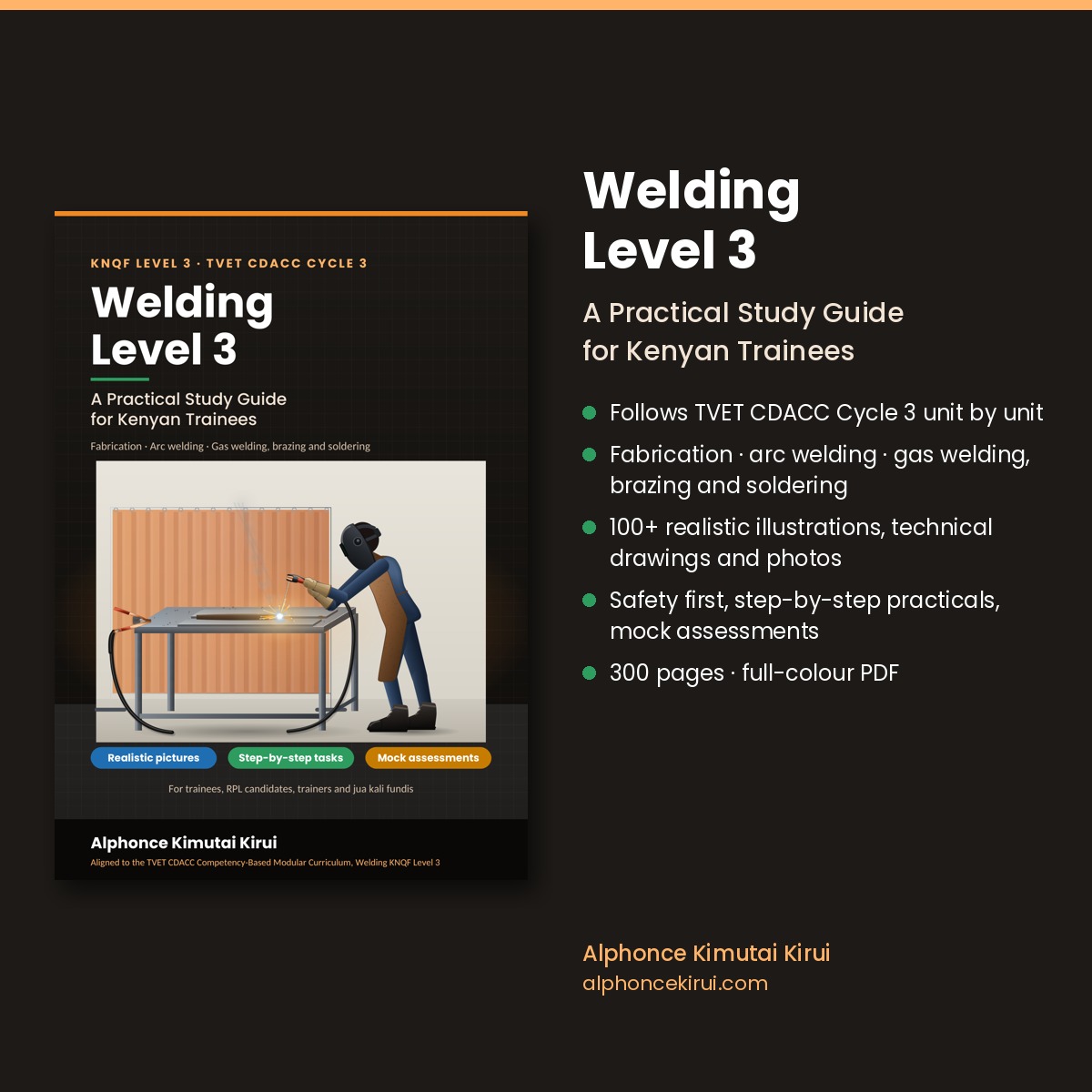
This free revision page is for trainees, RPL candidates and fundis preparing for the CDACC Welding Level 3 assessment (KNQF Level 3, Cycle 3). The qualification covers fabrication, arc welding, and gas welding with brazing and soldering, on mild steel up to 6 mm, mostly in the flat and horizontal positions, plus an industrial attachment.
Units and hours
| Unit of competency | Hours | What you must be able to do |
|---|---|---|
| Fabrication Processes I | 150 | Bench work, fitting up to 6 mm, sheet metal patterns and products, finishing |
| Arc Welding Processes I | 100 | Set up MMAW, weld flat and horizontal joints, arc cut, maintain equipment |
| Gas Welding, Soldering and Brazing Processes | 100 | Gas weld and cut, braze, solder and maintain oxy-acetylene equipment |
| Industrial attachment | 240 | Work in a real workshop under a mentor, keeping a logbook and portfolio |
Key notes by unit
Fabrication Processes I
- Fit a hacksaw blade teeth forward, with at least three teeth in the cut.
- Tap drill = thread size minus pitch, so M10 needs 8.5 mm. Tap in order: taper, second, plug.
- A frame is square when its diagonals are equal; a 600 × 400 mm frame has diagonals of about 721 mm.
- Tack diagonally opposite corners in turn, checking after every tack, and weld fully only after the final check.
- Bigger gauge number means thinner sheet. Allowances: hem H, double hem 2H, wired edge 2.5 × wire diameter.
Arc Welding Processes I
- E6013 is a rutile, all-position electrode for AC or DC; its flux gives a gas shield and protective slag.
- Start at 30–40 A per mm of electrode diameter (about 95–130 A for 3.2 mm), then fine-tune on scrap.
- Keep the arc length about equal to the core diameter, with a 10–20° lean towards travel.
- Duty cycle: 60% at 160 A means 6 minutes of arc in every 10, then 4 minutes rest.
- For 5–6 mm butts, use a 60° single V, 1–1.5 mm root face and 2–3 mm gap. Horizontal work needs 5–10% less current.
Gas Welding, Soldering and Brazing Processes
- Never use acetylene above 1 bar (15 psi). Fuel-gas nuts are grooved with left-hand threads.
- Fit flashback arrestors, leak test with soapy water and purge hoses before lighting.
- Light acetylene first with a spark lighter, then add oxygen for a neutral flame (used on mild steel).
- Filler rod for gas welding: half the plate thickness plus 1 mm.
- Brazing filler melts above 450 °C, solder below; neither melts the parent metal. Steel is brazed with brass rod and borax flux.
Practice questions
What tap drill suits an M10 thread with 1.5 mm pitch?
Answer: 10 − 1.5 = 8.5 mm.
How do you check a tacked 600 × 400 mm frame is square?
Answer: Measure both diagonals; they must be equal, about 721 mm each.
What allowance do you add for a wired edge with 3 mm wire?
Answer: 2.5 × 3 = 7.5 mm.
Why notch the corners of a box blank before folding?
Answer: So the sides fold up without overlapping.
What starting current suits a 3.2 mm E6013 electrode, flat position?
Answer: About 110 A, then adjust 5–10 A at a time on scrap.
A machine is rated 35% at 200 A. How long can you weld in each 10 minutes?
Answer: 3.5 minutes, then 6.5 minutes rest.
Your fillet weld has a groove along the toe. Name the defect and how to prevent it.
Answer: Undercut. Lower the current, keep a short arc, travel steadily and pause at the toes.
Why is acetylene never used above 1 bar?
Answer: Free acetylene becomes unstable when compressed above about 1 bar.
The flame burns back into the hose with a bang and smoke. What is it and what do you do?
Answer: Flashback. Close both cylinder valves at once, keep people away, replace any arrestor that has worked and damaged hoses, and find the cause.
How does brazing differ from soldering?
Answer: Brazing filler melts above 450 °C, soldering filler below 450 °C.
Common mistakes in the assessment
- Treating the written test as most important: theory is only 10% of each unit.
- Forgetting housekeeping and maintenance, which carry real marks.
- Leaving the portfolio and logbook to the last week.
- Working unsafely: a good weld made without a helmet still loses marks.
- Copying work, which is malpractice (Y) and can stop certification.
Safety essentials
- Use about shade 10 for 2.5 mm rods, shade 11 for 3.2 mm, and 4–6 for gas welding.
- Never weld galvanised steel without extraction; zinc fume causes metal fume fever.
- Keep combustibles 10 m from hot work and never weld drums that held fuel.
- Store cylinders upright and chained, and never oil oxygen fittings.
- Cool burns under running water for 20 minutes.
Get the full guide
The full guide has about 300 pages and 16 illustrated chapters, with worked examples, practical tasks, answered practice questions, a mock assessment for each unit, a glossary and logbook pages. Get the full guide or read the free sample.
Revision offer: buy any 2 CDACC study guides and use code REVISION2 at checkout for KES 300 off. Valid until 15 December 2026.
This is an independent study guide. It is not published or endorsed by TVET CDACC, TVETA or the Ministry of Education.